Wednesday Bach Blogging: Canadian Brass and Four Fugues


The Canadian Brass, at the 2012 Festival de Sion, in Sion, Switzerland, performing Johann Sebastian Bach's "Little" Fugue in G minor, BWV 578.

From some time in the 1980s, an earlier lineup of the Canadian Brass having some fun swinging a few bars of the Fugue #2 from Bach's Well Tempered Clavier Book 1:


One of J.S. Bach's most well known pieces, the Toccatta and Fugue in D minor, BWV 565, gets the Canadian Brass treatment in a 2009 concert video:


And if you have an hour or so, here's the original version of the Canadian Brass in an audio-only recording, of their transcription of one of J.S. Bach's last works, The Art of Fugue, BWV 1080:


My apologies - since finding and posting the above video, it appears that a few commercial ads have been stuck into the middle of this performance.  Kind of jarring and takes away from the beauty of the music, but it's a reminder that as ever, nothing is truly free of charge.

A final note - for everyone with so limited a musical vision that they cannot imagine the music of Johann Sebastian Bach being played in any fashion except for what they might consider to be "as Bach intended it to be", or something equally narrow minded, the Canadian Brass, among many others, show us that the ways in which Bach's work can be interpreted are limitless.

Daylight Savings Time


Spring forward. Fall down. Mass temporal hysteria. What a freakin' dumb ass idea.

Wake up, sheeple! 


1998 Fender MIM Strat Makeover, Part 1


    Recently, I picked up a nice condition 1998 Fender MIM (Made In Mexico) Standard Stratocaster. Actually, really really nice shape, almost like new, hardly a scratch, no fret wear; there were still traces of the plastic film overlay on the pickguard. I wasn't really in the market for another Strat, but when this was offered as part of a multi-item trade deal, I thought it might make a decent first electric guitar for our musically inclined son, so I went for it.

Strats and Teles have been around for more than 60 years, which means most of their history and lore predate the internet. In years past, this particular color combination - a black body with white pickguard - has had a few nicknames: "Tuxedo", "Black and White", and "Penguin", among others, but no one ever uses those terms anymore. I like penguins (who doesn't?), so we'll call this Strat the Penguin.

The Penguin style is possibly the single most iconic of all the Strat color combinations, and a lot of great music has been played on Fenders with this look. It's a great classic look, and we should probably just keep it the way it is, but oh well, that's not how we do things around here. We always mess around with our toys, until they look like something that belongs to us, and not someone else.

As soon as he heard I'd picked up the Penguin, David in Massachusetts suggested a style makeover, and sent a picture of what his dream Strat would have looked like during his own teenage years - a black body, rosewood fretboard, and a reddish brown tortoise pickguard:


Vary classy! A few days later David sent along a new Fender brand tortoise pickguard, and I ordered some Allparts cream colored pickup covers and knobs, and a tortoise trem cover. So now, let's get to work and make this happen.

First I'll say that although I have a workbench for the messier stuff I do, such as tube amp work (and rebuilding bikes), I like to do guitars on the kitchen table - there's an even, unshadowed northern light from the big sliding glass doors, and coffee and/or beer are a lot closer to hand. As usual, the big old pink towel goes over the antique '50s table, to protect both the guitar and the table, and family harmony as well.


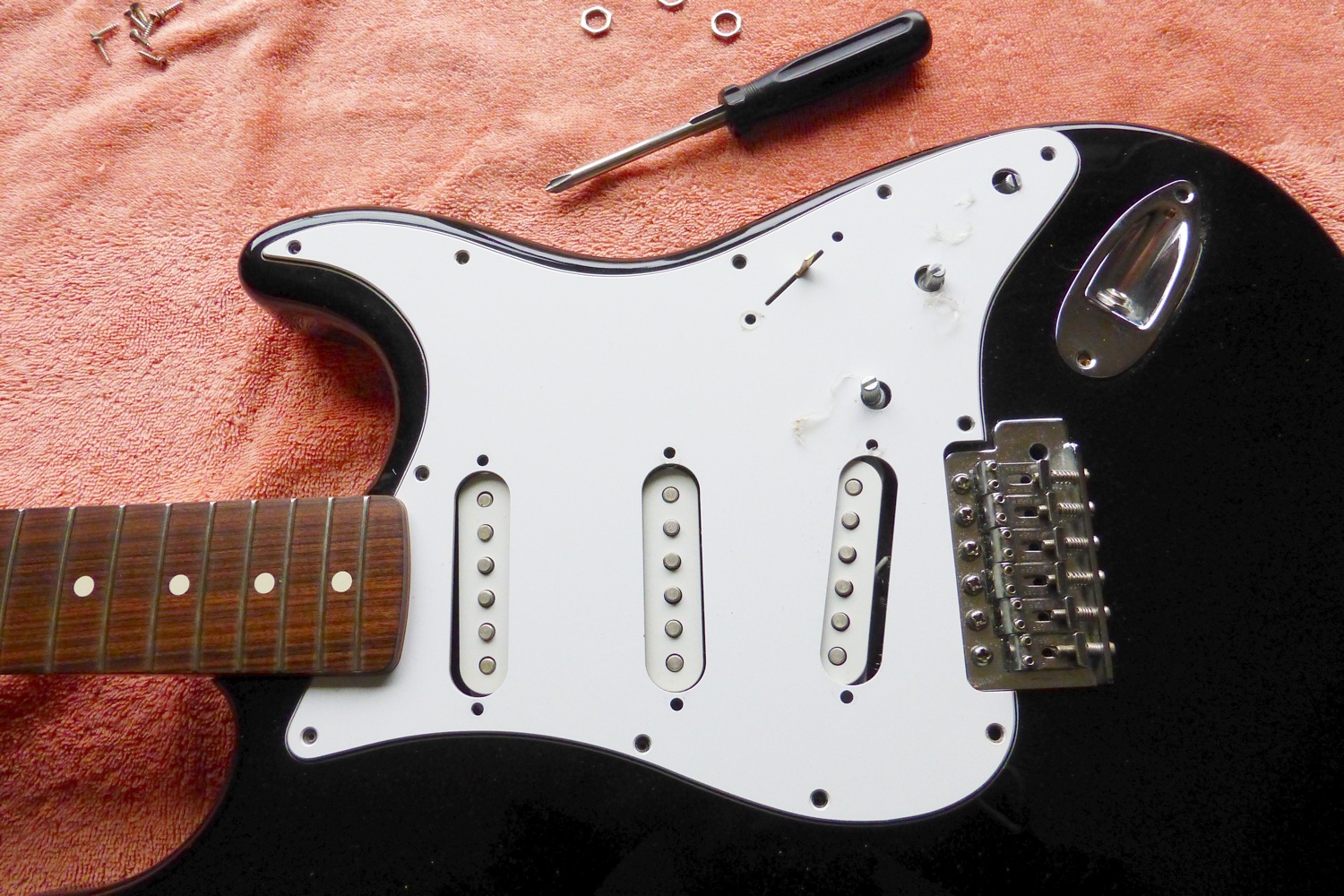
This ain't going to be a Penguin much longer - first thing, after removing the strings, the woodscrews holding the pickguard to the body are removed, as are the machine screws holding the switch and pickups. Also, the nuts securing the potentiometers, or "pots", are loosened up with the correct tool, a Craftsman 13mm deep socket - more about that later. Now, all we have to do is lift off the 'guard, and everything else just sits there:


Here's a close up of the control area of the white pickguard; note the remains of the original transparent plastic film overlay:


Next, our new parts. While sometimes I "cheap out" when I do low-buck projects, it only makes sense when doing a makeover of an essentially new guitar, to get as high quality parts as possible. In this case, we can't go wrong with Fender and Allparts brand stuff:


Next, remove the old pickup covers, and place the new ones over the pickups. We'll take the new tortoise pickguard out of the bag; in the next picture, it still has the plastic film on it, and looks redder than it really is. Once we take that film off, the actual color is a bit browner. When guitars are assembled at the factory, the film is kept on, to reduce scratching both at the factory and also later at the music store. Today, we'll zip the film off right away, and use an old fashioned precautionary method to minimize scratches - working slowly and carefully.


I didn't take any pictures while fitting the pickups to the pickguard, mostly because it's a two-handed procedure. Also, everyone's got their favorite method, whether to flip the pickguard over and install the pickups down over it, or hold the pieces sideways, or to hold each pickup with the springs balanced in place and slip it into its respective hole, while starting the screws from the top by hand - that's the way I do it, but whatever works best for you, okay. In any case, be very, very cautious around the really thin pickup coil wires, between the coil itself and the solder joints - one slip, and it's time for a new pickup.

These pickups seemed to have larger diameter machine screws, and the Allparts vintage-spec covers had holes a bit too small, so it was necessary to ream them out slightly with an oval section hobby file. Just about 5 seconds of twirling the file gets it:


After installing the pickups, place the pots one by one into their holes, and tighten the nuts, first by hand, and then with the preferred tool - a shiny new-ish chrome plated Craftsman 13mm deep socket.  The nicely done plating on the socket reduces scratching, almost to none. Use no ratchet handle, just do it by hand - hold the socket lightly between your fingers, and at this point just get it barely snug:


Then, re-attach the switch. Before final tightening of the pot nuts, flip the pickguard over and check the alignment of the pots, so the wiring doesn't get pulled too tightly. Also, inspect the whole control section, including the solder joints; in this case, the black wire from the neck pickup pulled off its grounding point on the volume pot - an obvious cold solder joint, which had to be reattached. The tape holding the neck and middle pickup wires together also needed a re-wrap.


One thing I found out is that Fender obviously listened to everyone back in the '90s, when it was obvious that their Standard line MIM guitars had sub-standard electronics. My own '91 MIM Strat came from the factory with nasally, thin sounding pickups and cheesy pots and switch. By 1998, and possibly earlier, Fender was using decent quality CTS pots and CRL switches, and the ceramic magnet single coils in this particular Strat are very good sounding - sweet and full bodied, with a bright clear top end, and balanced lows and mids - really Hi-Fi.

In fact, Ron, the previous owner, had installed a Joe Barden pickup in the neck position, and took it back out soon afterwards, since it didn't sound as good as the stock pickup. I played this Strat both before and after the pickup swap, and again when the Barden was removed, and I totally agree with Ron. I could go on here about tone actually being in your fingers, and how a lot of players go insane, as well as lose a lot of cash, substituting pickups, bridges, and other parts, chasing after some mythical tone, but that's another story.

Here's a shot of the reattached pickup black wires at the volume pot, with a "hot" flowing solder joint:


Speaking of hot joints, marijuana became legalized recently here in Oregon, which I discovered when I joined a rock cover band. But I digress. Here's a picture showing the nice, large pickup cavities on this MIM body - a great idea, makes it easier to fit a humbucker or a P-90, and placing a loaded pickguard down over a body is a whole lot easier, without worrying about having every wire exactly in place. Also, that's some thick-ass paint in there:


Next, final tightening of the pot nuts. Remember, this isn't an auto engine, and nothing needs to get death-grip torqued, just snugged down; so hold the 13mm socket lightly, and when it starts slipping between your fingers, that's plenty tight enough.

Before putting all the pickguard screws back on, do a quick electrical test. I have a short jumper cable with a 1/4" plug on one end, and bare wires on the other, that the alligator clips on the probes of my ancient Sperry multi-meter can grab onto:


This time, everything's okay, hooray. If we had done any major replacement work, it's a good idea to put just one string on, plug the guitar into an amp, and make sure the volume and tone pots all work.  But in this case, since it was fine before, it should still be good. Is that being foolishly optimistic, or what?

So now, we can put all eleven of the pickguard screws back in. First, a couple of points: in the picture above showing the new package of knobs, you can see two wood screws at the top of the photo - these are special screws which have a wider diameter un-threaded shaft section between the head and the start of the threads. These go into specially enlarged holes at either side of the bridge, and help to locate the pickguard more exactly so the tremolo bridge plate doesn't bind against the edge of the 'guard. Not all Strats have this feature, but some do.

Also, make sure to run all the screws down only about 3/4 of the way at first, and wiggle the pickguard a bit so all the screws are equally mis-aligned. I say "mis-aligned" because whenever you change pickguards, no matter how high quality the part, the screw holes are never going to be in exactly the same location - so spread out the error, and that way none of the screws is going in sideways.

Final tightening: just like putting on an automobile tire, go around all the screws and tighten each a turn at a time. And remember, you don't need to tighten these screws a lot; you don't want to strip out the screw holes in the body, or deform the plastic material of the pickguard. Look closely at an attachment screw where it goes down through its hole - if you tighten too much, you'll see the plastic start to deform and dimple, and begin to create a divet. As time goes on, these stress points will turn into fractures - not a good thing. So, run each screw down to just barely snug with a thumb and one finger on the screwdriver, and then back off a 1/4 turn - you'll see that deformation disappear. And no, that pickguard ain't gonna fall off, unless... Uh, what exactly do you do with that Strat, anyway?

The next picture shows my big mistake - I was in too much of a hurry when I ordered, and got different color knobs and pickup covers. The knobs are "Cream", and the covers are "Vintage Cream", which has a small touch of greenish tint to it. I like that vintage cream color, so I've already ordered another set of knobs, and in a few days, we can see how it all looks when we're done.


In the meantime, here's a shot of the body as it sits right now. Not bad at all, and getting close to classy:


And here's where spending a bit more, and getting the correct part pays off. This is an 18 year old Fender Mexico Stratocaster, and the brand new USA pickguard was made by Fender as well - notice how precise the fit is, both around the tremolo plate, and at the neck. That's not a 22 fret neck with a fretboard overhang covering a sloppy fit - it's 21 frets, and the curve at the end of the neck matches the pickguard's curve very close to perfectly.

Depending on your browser, you can probably click or tap on the photo above to get a closer look.

Next time in Part 2, we'll put on the tortoise patterned trem cover and "vintage cream" knobs (as of this writing, they're still in the post, but should be here soon), adjust the pickup heights and general setup, then string this black and tortoise beauty up and take it for a spin.


Strat And Tele Pickguards - I Never Noticed That


    Over the years, I've owned a few Telecasters and Stratocasters.  And no, I'm not a "collector" or a dealer, just a player.  But in all this time, there hasn't been a couple of uninstalled pickguards laying around, until today.  And so I never noticed how gracefully their sensual looking curves fit together, side by side.  Amazing.


Thanks to David in Massachusetts for the really nice Fender Strat tortoise pickguard.

Cover Bands: Doing A Cover The Right Way, And Having Fun Doing It


    As Marty and Bobbi Culp (above) have proven, it's possible to do cover versions of popular songs in a way that best suits your own musical style, and also have a lot of fun doing them.

The title of this post may be "Doing a cover the right way...", but there isn't any right or wrong when it comes to music - as long as you're doing it, that's the only important thing.  When we're young, it can be instructive to emulate our heroes; singing their songs and playing their riffs over and over is a great way to get fluid on an instrument, and gain vocal technique.

It's when we stop trying to sound like someone else, that's when our own individual style automatically emerges - it's basic human nature, and it's a good thing.  Some people never stop trying to emulate others, and some players never even tried to; probably, all of the most creative and truly unique musicians and singers in musical history fall into the latter category.

Creating your own art is the most satisfying experience in life, period.  But, it's fun to do a cover every once in a while, and whether you do it exactly like the original version, or if you put your own personal creative spin on it, it's all the same, it's all good.  That is, as long as you don't get too obsessive about any aspect of it.  At the risk of sounding pedantic, or being a sensei, I'll just throw this out: trust your own instincts, believe in the song and believe in yourself, and remember to give back to the music, something from your own soul, as much as you've received from it.

In no particular order, here are a few examples of great cover versions; some are closer to the original recordings, and some are so far out in the cosmos that they're still orbiting some distant musical sun.

First, The Beatles performing the Isley Brothers' "Twist And Shout":


Here's the Grateful Dead, jamming on Buddy Holly's "Not Fade Away":


Jimi Hendix's "Purple Haze", as rocketed into the galaxy by the Kronos Quartet:


Matthew Sweet and Susanna Hoffs singing Neil Young's "Cinnamon Girl":


"Walk Away Renee", originally done by the Left Banke, as re-imagined by Linda Ronstadt and Ann Savoy:


Wilson Pickett, with (I never knew this before) Duane Allman on guitar, doing his rendition of The Beatles' "Hey Jude":


James Taylor's bittersweet social awareness ballad, "Millworker", totally slammed in a powerful performance by Bruce Springsteen:


                                                                 *            *            *

Part 1 of this series, "It's Only Rock And Roll, But Maybe Not".

And Part 2, "How I Joined A Cover Band, And Survived To Tell About It".


Cover Bands: How I Joined One, And Survived To Tell About It


I can't believe I joined a rock cover band

A few months ago I joined a rock cover band. Didn't really mean to, but sometimes I'm clueless. I got a call - did I want to play guitar in a rock and roll band? Sure, why not? It's been awhile since my last really get down and kick it rock gig - hardly anything more fun than having a couple beers, plug some pedals into a loud amp, turn it all up, and groove. Trouble is, I had no idea just how much fun, or lack of it, there would be.

"You can't sing worth a shit!"

At the first couple of rehearsals, Barbara the keyboard player played and sang well, and got down to business. By the third rehearsal, her behavior became erratic, playing only in a kind of lounge piano style, and sang random harmonies with ever shifting intervals. I should mention here that pot has only recently been legalized here in Oregon, and copious amounts of cannabis were being consumed by some members of the band, Barbara included; I'll get back to that later.

At the fourth weekly practice session, Barbara started going into a no-dead-air mode; between songs, she would keep playing whatever song we had been working on, singing loudly in a Bill Murray kind of voice. After we had run through a song with a lot of harmonies, she started yelling, at high volume over the PA system, "Jim! (that's me, by the way) You can't sing worth a shit! Jack! You're singing way too fucking loud! Don't you know the concept of background vocals?!? Jeez, I can't hear myself think!!"

We took a break, went outside, and a lot more smokey weed was smoked. Barbara also quickly downed a couple bottles of beer out of the studio fridge, and when we went back inside to practice, she stared off into space for awhile, then quietly announced she had an important appointment, and packed up and left. We never saw Barbara again.

The Robot Backup Singer and the Karaoke Cowboy

The band's primary singer, Jack, hasn't had much live music experience; he practices singing along to downloaded karaoke tracks, and I guess that's his comfort zone. Our first couple of rehearsals involved all of us playing along to prerecorded mp3s. Maybe that's how it's done in the 21st century? Jack is currently a member of four different bands; what those groups all have in common are Jack, the karaoke tracks, and his song book. After flipping through that book, I ask - are we doing any original tunes? "Nah, Mark (Jack's best friend, and the bass player in the band) doesn't want to do originals - it's too much like doing real work."

At rehearsal, everyone but me is sitting down. Jack, having memorized no lyrics, intently studies his song book as he sings. Mark is on a low chair close to the floor, his pipe and lighter on a stool close at hand. Ronnie the drummer is of course on his throne. And Barbara is (or was) on another stool, a lot higher than Mark. Well, maybe they're equally high. I ask, Uh - when we play out, am I going to be the only one standing? Jack says, "Is that a problem?" Mark and Jack look at each other; "If it makes you feel any better, you can sit down, too." This doesn't quite seem like rock and roll anymore; is this how it feels to get old?

Jack's pedal board includes a digital vocal effects processor; it's got pitch correction, voice altering capabilities, effects, and a harmony generator. Jack affectionately named his digital box "Buffy", and Buffy makes occasional personal appearances during the set, as a robot female backup singer. Very eerie, very strange, especially after feeling second hand effects from the thick clouds of MaryJoWanna smoke drifting through the studio. Suddenly, a disembodied other-worldly alien female voice comes shrieking through the fog! My first instinctive impulse is to run away.

Whoa, that's some powerful weed, man...

I've already mentioned the copious cumulonimbus clouds of mind altering smoke wafting hallucinogenically throughout the rehearsal studio. Here's a curious thing: after the first initial effects of inhaling all that second-hand smoke - feeling light headed, a bit queasy - I started really getting into playing those boring '80s Top 40 cover songs. Great, feels like I'm floating over the music, and solos are especially intense. Never mind that I feel sluggish and stupid for days after every rehearsal. "Oh, you're back from band practice - how did it go?" "Huh? What? Where?"

On a break, in the "smoking section", a picnic bench outside with a couple ashtrays on it, Mark was having fun messing with me. "Come on, Jim, get in the spirit, have a toke, man!" Okay, okay... I'll accept the peace pipe. First drag, I start coughing, a lot - wasted the hit. I immediately inhale another deep one, and after passing the pipe on, I feel a cough coming on again. Doing a Zen meditation thing, I mentally will myself to stop coughing, and hold the smoke in for as long as I can, to get the max effect. Feeling slightly dizzy, I feel like I want to walk around a bit, enjoy the sunshine among the trees around Ronnie's countryside studio. I stand up, walk towards an inviting grove of trees, and immediately pass out.

When I come to I'm flat on my back, looking at the sky, and everyone else is standing around, seemingly hundreds of feet away, and staring down at me. The sun is shining, the birds are singing, my ears are ringing and my head hurts, my glasses aren't on my head anymore. "Hey, you okay, dude?" Whoa, that's some powerful weed. What was that anyway?" "It's called Blue Ruin, man."

The name of the band, by the way, is The High Guys. Maybe it should be Blue Ruin.

"Just play the gawd dam riff"

After getting over my initial hesitance about doing covers, I learned a couple songs to sing and brought them to rehearsal. "White Room" came off well - Ronnie, a really great drummer, jumped right in with the 5/4 Ginger Baker drum riff in the intro, and it was fun for me to do the viola parts on distortion laden guitar, as well as the long wah-wah solo. Good practice for me, as well, to sing and play a fairly complex song simultaneously, without messing up big time. I can't walk and chew gum at the same time, but luckily, it turned out okay.

"Cinnamon Girl" was another story. Mark actually stopped me in the middle of the song - "You're playing the wrong chords!" Oh, sorry - which chords are wrong? "You're supposed to do the C again before you go back to the D, in the bridge." Well, maybe I'm doing my own version. "Yeah, but that's not how the song goes, man - do it right!" Well, that's how I play it, and maybe I can give everyone a chord chart. "Either do the song right, or don't bother doing it!" Whoa. Haven't been yelled at so much since third grade.

Mark wasn't very happy when I did slide guitar lines in his cover of the Dire Straits tune "Sultans Of Swing" - "There's no slide guitar in that song!" I thought it would sound great with some. "It doesn't matter what you think, that's not how the song goes!" On another one of his songs, there's a tiny lick, a flatted seventh with a quarter tone bend, after a strange 3/16 rest. Mark insisted that he couldn't start his vocal unless that micro-lick was in exactly the right place. After running through that stretch of the song more than twenty times, I said - does it have to be so exact, does it really matter? - this is just a cover band. "Just fucking play the gawd dam riff!"

Mark, it turns out, was a Strict Rock Fundamentalist, and his best friend Jack is probably a Middle Aged Musical Role-Player. Some people might say that Mark was also a bitter, curmudgeonly old coot, but hey - nobody's perfect, least of all me. I'm starting to realize I was only looking to have a bit of fun playing music, and sorry, but I just can't get serious about, or be very interested in old top 40 tunes.

Do what you like, and like what you do

I know some of the stuff I encountered with the High Guys cover band sounds bizarre or unbelievable, but as Dave Barry likes to say - I swear, I am not making any of this up, honest. Maybe I should have worn my other, less beat up pair of glasses, or tilted my head sideways - things might have been clearer or made more sense. That seems to work for dogs. The head tilting part, not the glasses. Or maybe, since it's legal now, I should have just gotten high, and stayed high.

A long time ago a college freshman advisor told me that whatever we do, it should either pay a whole lot of money, or be a whole lot of fun. And if it did both, that was the next best thing to paradise. Since I wasn't having a ton of fun with The High Guys, or making any cash, you can guess how this story turned out. Sometimes, though, I kind of miss those guys - high or not, there was never a dull moment hanging around with a bunch of real characters. And their robot backup singers.

*            *            *

Next time on the Origami Night Lamp blog, "Doing Covers The Right Way, And Having Fun Doing It".

Also, Part 1 of this series, "It's Only Rock And Roll, But Maybe Not".
 

Cover Bands: It's Only Rock And Roll, But Maybe Not


Recently, I went to an opening exhibition at a local art gallery, featuring the works of a collaborative group of five artists working in oil on canvas and bronze casting.  Ranging in age from their late forties to sixty, they were possibly a bit past their prime, so to speak, but still had a lot to offer the art world: each of them talented, articulate, and focused on bringing their collective artistic vision to life.

What was surprising was the group's decision to forgo any aspirations to originality, and instead to apply their mutual creative energy into recreating works by well known artists from the past.  Elbowing my way through the opening night crowd, I was stunned to see nearly pitch-perfect copies of pieces by Picasso, Van Gogh, Monet, Cezanne, Degas, and other famous masters - the exhibition was essentially a greatest hits show, featuring reproductions of paintings and sculptures by the biggest stars in all of 19th and 20th century art history.

A member of the collective summed it up, "We feel that basically, it's all been said before, and let's face it, a lot better than anything being done today. After years of struggling to create original pieces that never sell, it was only logical for us to get together and form what is in essence an art cover band. Audiences in the 21st century don't buy original art anymore, and as working artists trying to make a living, it's a hell of a lot easier to get people to come out to a show like this - I mean, just look at them - swilling down that cheap white wine, and handing over their credit cards like there's no tomorrow!"

If that story above seems a bit far-fetched, well, it's because it didn't really happen.  Not in the art world; not yet at least.  But it's happening with ever increasing frequency in today's music world.

The Long Night Of The Living Cover Bands

Sometimes it feels like we're living in some sort of musical "Groundhog Day" endless loop.  For most of my adult life, what's come out of the radio has been a never ending stream of the same boring confessional singer-songwriters emoting to perfectly crafted pop love ballads, and rock bands influenced by bands that were influenced by bands that were influenced by... on and on seemingly forever.

Listen to any hit pop tune from the mid '90s, and it's no different from anything being produced today.  Walk into a blues bar, and the band will no doubt either be playing an old chestnut from the golden age of Chicago blues, or something really close to it.  And if any kind of music could have escaped spiraling down into self parody, it should have been rap/hip hop, once the most dynamic and fast evolving of any new musical forms - but sadly, no.

Here in Eugene, the biggest musical draws are the two or three Pink Floyd cover groups that come through town on a regular basis; at these shows, mobs of enraptured fans of the moribund British band sway to familiar tunes played with note perfect precision by the well-paid Floydian archivists, flicking and waving their lighters in unison, and, eyes closed, singing along to song lyrics memorized long ago, reliving happy nights spent getting high and spinning Floyd LPs over and over.  But.  It's not really Pink Floyd.  And they may call themselves "tribute" bands, but they're more like opportunist parasites with their hands out, happy to fleece cash from aging hippies pining for their lost youth.

Middle Aged Musical Role-Players and The Strict Rock Fundamentalists

The rise in popularity of the rock cover band has helped create a whole new class of player: those who took a few music lessons when they were younger, maybe joined a band, but then gave up their rock star dreams and went on to careers, success, stability and security, and possibly an almost satisfying family life.  At a certain age, and finding themselves with free time and some extra cash, they may go down to the big box music store, buy a guitar and amp resembling what their childhood idol used, and then get on craigslist, do the hook-up thing, and find other like minded players to act out their rock and roll fantasies with.

Another related musical cultural phenomenon that's developed in the last couple of decades are the Strict Rock Fundamentalists.  Something like a Christian fundamentalist, or an Appalachian snake handler, or a radical Islamist, if you get too close, they're kind of scary.  These wild eyed zealots have an almost religious belief in the sanctity of The Original Version; the Strict Rock Fundamentalists can tolerate no deviation from gospel, no addition or subtraction or variation from the hallowed text, no extended jams, no alternative reading of their revered rock and roll hymns.

If you ever try taking a tune from the holy rock canon off into another direction, or play an instrument that's not in The Original Version, or worst of all, start a Grateful Dead style jam on it, the Strict Rock Fundamentalist will stop the song, glare at you, and solemnly intone the sacred words, "That's not how it goes, man!", or, "Those are the wrong chords!"  So far, no infidel has been beheaded for irreverent rock and roll blasphemy, but don't be surprised when it happens.  Maybe that's what happened to Jerry.

Next time, "How I Joined A Cover Band, And Survived To Tell About It".

Stay tuned!

Also, Part 3 of this series, "Doing A Cover The Right Way, And Having Fun Doing It".

Wednesday Bach Blogging: Catrin Finch, Italian Concerto BWV 971


    Johann Sebastian Bach's Italian Concerto, BWV 971, transcribed for the harp, and performed by Catrin Finch.  This an audio only clip, but nonetheless it's a wonderfully toneful, and masterful, interpretation of one of Bach's most melodic pieces.  When played on a harp, the second, Andante, movement is especially haunting.


Grosbeak Finch In The Rain


    We had one of those days recently - rain all day and night and the next day, too.  No showers, just steady pouring rain, for a long time.  Not complaining, really; I kind of knew what to expect, when we moved out from dry Colorado, here to the Northwest Rain Forest.

Just happened to be looking out the kitchen window, and a colorful bird landed on the back yard fence.  In our south Eugene hills neighborhood, we see a lot of different birds - some here year-round, some seasonal visitors, and a few just passing by, rarely seen.  This particular Evening Grosbeak Finch (Hesperiphona vespertina) probably spends most of its time at higher elevations, in the forested woodlands of the High Cascade Range to the east.  What for us here in the low lands is a long steady rain, accompanied by cooler temperatures, would be a fairly heavy snowfall up in the mountains; and this backyard visitor is most likely on the move from one climate zone to another.

The Grosbeak stuck around for a short while, looked around, went to one of the suet feeders we have set up, and then, after having a few quick bites, took off again through the rain, heading west.


Wednesday Bach Blogging: Lichtenerg and Marshall, Gigue from Partita No.2 in D minor, BWV 1004


    Caterina Lichtenberg on mandolin, and Mike Marshall on mandocello, performing the Gigue movement of Johann Sebastian Bach's Partita No.2 in D minor, BWV 1004.  This performance was part of the Mandolin Magnificat event held at Northwestern University in Evanston, Illinois, in March of 2009.

Enjoy!