Wednesday Bach Blogging: Concentus Musicus Wien, Double Concerto For Violin And Oboe


    Concentus Musicus Wien, with Nikolaus Harnoncourt directing from the cello, playing Johann Sebastian Bach's Double Concerto For Violin And Oboe, BWV 1060 in C minor.  The soloists are Alice Hoffeiner Harnoncourt, violin, and Jurgen Scheftlein, oboe.  First movement, Allegro, above.

Composed circa 1717 to 1720 when he was employed as a court composer for Prince Leopold of Anhalt-Kothen, this piece was also transcribed by Bach as a concerto for two harpsichords.  As a work in concerto, or concert form, meant to be listened to with no other purpose except enjoyment of the music for music's sake, we are reminded of how many other works of art were unable to be created by Bach, after he ended up with what was essentially a dead-end job as Kappelmeister of the St. Thomas Church in Leipzig, a position he held from 1723 until his death in 1750.

Stuck with having to come up with new music for the church on a weekly basis, as well as conducting and training the choir and small orchestra there, Bach never again had the time, or the freedom, to write very many more lovely, melodic secular pieces such as this concerto.  Cantatas, Masses, and Passions served an important purpose in the very much more religious times of the mid 18th century, and Bach diligently applied his genius composing them for the greater glorification of God, but something, maybe the 'fun factor', is missing from his music during his later life.

Not so with the Double Concerto for Violin and Oboe - there's a lot of intricate and interesting harmonic interplay going on here; in the slow second (adagio) movement, there is a particularly mesmerizing interwoven double melody shared between the oboe and violin - like a haunting, lyrical love ballad sandwiched in between a couple of up-tempo dance numbers.  This is simply some of the finest music ever written by anybody at any time, every bit as enjoyable to listen to now as it must have been then, almost 300 years ago.

The second, Adagio, movement:


And the third movement, also Allegro:

Testing Guitar Tone Capacitors, Part 1

capacitor, test, box, Sprague Black Beauty, Cornell Dubilier, Vitamin Q, clips, custom, vintage

Like most players, I never thought much about guitar volume and tone controls until one night, just before a concert gig in Maastricht, Nederlands, my main (the only, actually) tour guitar started making loud scratchy noises, and suddenly went dead. Only minutes before the show and desperate, I calmly took the control plate off, bypassed the pots, and wired the selector switch straight to the output jack. All the while being yelled and whined at by the bandleader (who recently finally found some peace in his life). During our set, I was surprised at how much better the guitar sounded - more highs and lows, more volume, and overall a crisper, toneful, and more dynamic sound. Ever since then, most of my guitars have had no tone control.

Last year I bought a Strat from friend David, and he gave me an old tone capacitor to try out with it - an ancient paper in oil cap that many people call a "Bumblebee", and it sounded amazing.  Instead of just rolling off the highs, the tone control had a sweep that was almost like a wah pedal, and within that range were some surprisingly good and useful tones.

I should have kept that 'Bee cap, but I had already committed to selling the Strat's pickguard assembly, and that capacitor stayed in there.  Lately, I've been thinking about the sound it had, and now it's time for a tone pot in the Strat-O-Parts-O-Caster.  But first, it would be fun to test out a few different caps and hopefully find the one with the Golden Tone.  David agreed, and he contributed a few to try out:

capacitor, capacitors, vintage, paper in oil, poly, polyester, silver mica, polypropylene, polystyrene, tone

I already had a small pile of new and old caps:

capacitor, capacitors, vintage, paper in oil, poly, polyester, silver mica, polypropylene, polystyrene, tone

Okay, already that's way too many capacitors.  Luckily, most of these caps have values that place them out of the useful range for guitar tone circuits, which is from around .01uF to maybe .1 uF - just to make sure, we'll also test some outside of that range.  But - how do we test them?

You can use a meter and measure the capacitance, and whether the cap is shorted or open, but that won't tell you how it sounds.  Ideally we need some way of hooking each capacitor up and actually listening to it.

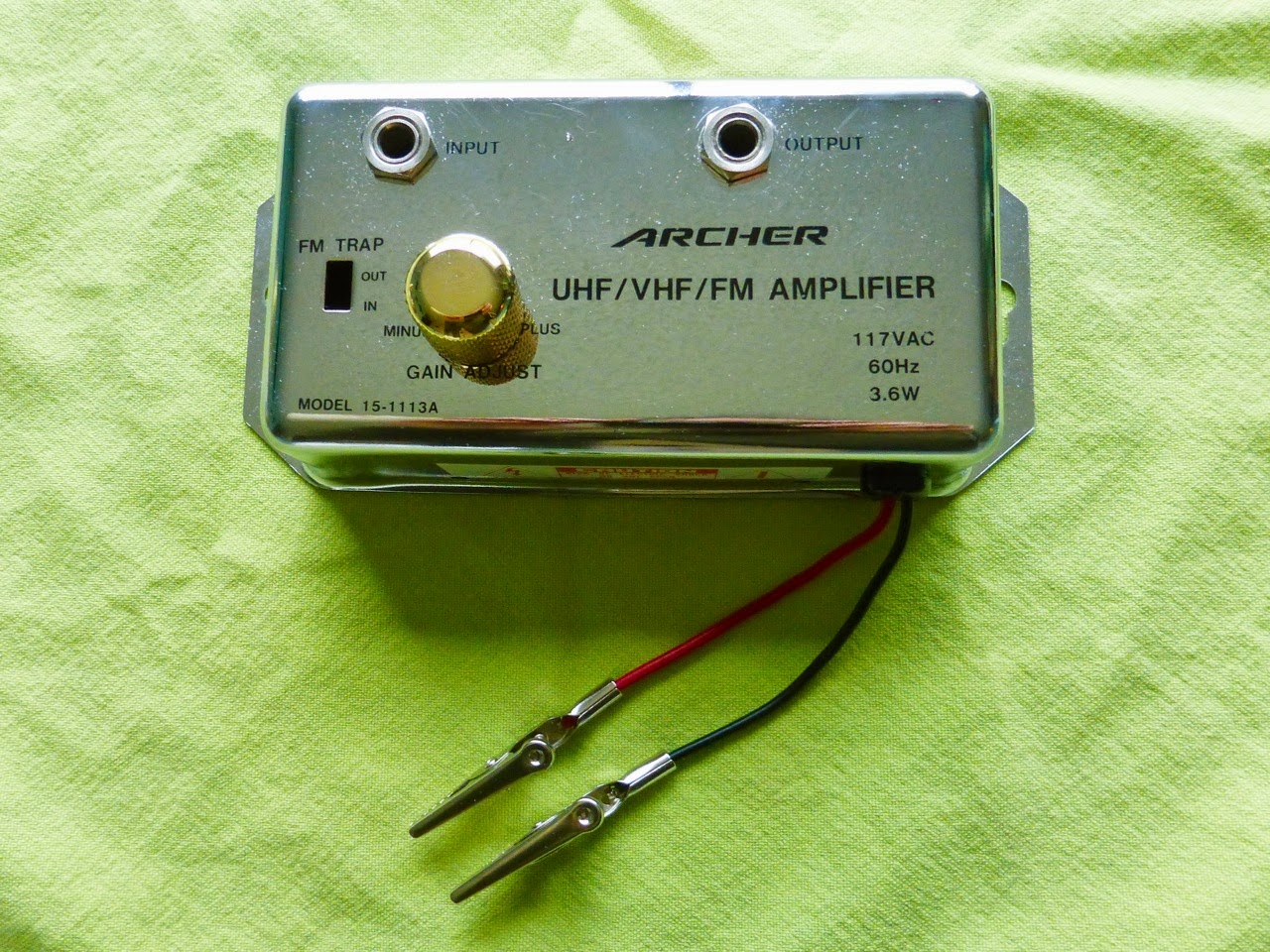
But it would be difficult, and impractical, to test a number of caps in place, at the tone pot of a guitar.  It might be a good idea to make an external box to plug into, and then into the amp.  I had a cool looking, but dead, vintage TV antenna booster like this one:


The coax jacks unscrewed and dropped down, taking the PC board with them, and the holes they were in fit 1/4" jacks perfectly.  The AC cord strain relief could serve the same purpose for the test leads.  Some drilling out made the gain adjust hole fit a 250K pot, wired like a guitar's tone control, except with two wires running out of the box attached to alligator clips, instead of a capacitor soldered between the pot and ground:

custom capacitor, cap. tester box, wiring, Switchcraft jacks, pot, potentiometer

 A gold Tele knob is a nice touch on the chrome box:

custom cap, capacitor test box, vintage, Archer antenna booster, case, clips, Tele. Telecaster knob.

Now, let's test some tone caps.

To save time, this will be audio testing only - how does the tone cap interact with a guitar pickup, through an amp, and how does it sound?  No measuring capacitors with a meter, no internet research, no thinking - we don't need facts or figures, or online opinions.  We're just looking for a great sounding tone cap.

In order to keep it consistent between tests, only the Strat Parts-o-caster will be used, usually in the middle pickup switch position.  And since it doesn't have a tone control yet, only the capacitor being tested will be heard.  However, if a particularly juicy sounding cap is found, I may check it out with another guitar or bass.

I should say here that I'm not going to talk about construction details, materials used (Mylar? Polyester? Paper in oil? Martian skin and peanut butter?), or the ages of any of these caps  - there's a huge amount of info out there about capacitors, most of it is contradictory, and much of it just sounds like hype or "cork sniffing" to me.  I'm a beer drinker, and I'll leave the wine tasting for others.

*            *            *

Okay, let's get to work.  First up:

,022uF, 10%, 400V, ITWN, test clip, tone cap, 1977 Gibson Les Paul TV Special

• Unknown maker, .022uF, "10%, 400V, ITWM".  This cap will be the reference capacitor for our tests, since it's the only one in this bunch that I've heard before in a guitar - it's an original tone cap from my '77 Gibson Les Paul Special, which I bought new in 1978.  I have to assume, knowing what level of care and craftsmanship that Gibson put into the rest of the instrument, that they knew what they were doing when they picked this capacitor.

Audio-wise, it's a perfect example of what a tone cap should be - full up, the guitar's high end still sparkles and chimes, backed off half way you can get some nice J. J. Cale style round and toneful solo lines, and rolled all the way down, you're in full jazz territory - big fat smooth tone, with no response peaks anywhere up and down the fingerboard.  Plus, from full counter clockwise up to halfway, there is a very slight, barely noticeable wah-ish effect.  Nice.

Cornell Dubilier Tiny Chief, .022uF,PJ4S22, 400 VDC, C-D, USA, cap, tone, vintage

• Cornell Dubilier Tiny Chief, .022uF. "PJ4S22, 400 V.D.C., C-D, U.S.A".  This came, I think, from a Hammond organ, and if so they also must have known what they were doing.  It's got good tone, very similar to the first capacitor, except that at full clockwise, all the way up, it has just a slight bit more top end.  Good range of tone control, also nice jazzy lows, and about the same small amount of wah at the low range as the Gibson tone cap above.

Sprague Vitamin Q, .01uF, vintage, tone cap, CPO5A1KE103K, 400 D.C., clips

• Sprague Vitamin Q, .01uF, "CPO5A1KE103K, 400 D.C.".  This is one strange capacitor.  It basically has only two tones - full up, it does noticeably lose a slight bit of highs, but not too much; then, through most of the pot's range, there's hardly any effect, very little roll-off, until you get close to full CCW (counter clock wise).  At that point suddenly there's a strange nasally mid range hump, with less lows as well as highs, and oddly, it becomes a bit louder - it sounds a lot like stopping a wah pedal in mid stroke, except there's no wah effect at all when sweeping the pot.  Like I said, very strange, and it might be fun to have in a guitar as an alternate sound, connected to an on/off switch instead of a pot, but as a variable tone cap it's about useless.

.33uF, 10%, 100V, 900, K9970-11, vinatge, tone cap, paper in oil, Conn organ, clips

• Unknown maker, .33uF, "10%, 100V, 900, K59970-11".  I got this one from Double Dave, and it's from a solid state Conn organ.  It's obvious that this cap is made from some kind of rolled paper and foil, and so it looks ultra cool - kind of like a Greek baklava pastry.  At .33uF, it's way out of the guitar tone cap range, and hooked up, it sounds like it.  When you turn the pot, it instantly starts rolling off the high end, with not too much change after that, until at full CCW, it sounds like a giant marshmallow ate your guitar. A noticeable bassy hump around G sharp, and no wah effect at all.  It was fun for a while, emulating the sound of an electric bass made out of sponge rubber.

Cornell Dubilier, .1uF, PM4P1, 400 V.D.C., vintage tone, cap, Hammond organ, clips

• Cornell Dubilier, .1uF, "PM4P1, 400 V.D.C.".  This is another very good tone cap - at full CW (clock wise), the Strat still sounded like a Strat, then there was a gradual tapering off of the highs through the range of the pot, and at full roll off there was, as expected, even less top end and upper mids than with a .022 cap.  At full CCW, it sounds ultra fat, with no humps or peaks, and I suspect it might make a nice tone cap for a bass.  Only a very small wah effect.

That's it for this installment; in Part 2, we'll test some more vintage and modern capacitors, as well as look at the insides of a 1950s Sprague "Bumblebee" cap.  Stay tuned!

Most photos above taken with a Lumix ZS-25.  Click or tap on any picture to access larger, higher def images.

Wednesday Bach Blogging: Apollo's Fire, Brandenburg Concerto No. 5


    The first movement of Johann Sebastian Bach's 5th Brandenburg Concerto may be considered the precursor to all the piano concertos that have come along since this piece was written in 1721.  Prior to this, harpsichords, being by nature soft voiced and non-dynamic, were only used as continuo, or accompaniment to more prominent instruments - violin, flute, horns.  Even if there had been no Bach, the ongoing development of louder and more dynamic keyboard instruments such as the forte piano assured the inevitability of the piano concerto form, most notably seen, and heard by audiences in late 18th century Vienna, in the virtuosic piano konƶerts of W. A. Mozart.

Besides his compositional genius, Bach was also a highly gifted organist, stunning listeners of the day with his fusion of the tonal majesty of the most powerful musical instrument in the world at the time - the church pipe organ - combined with his own harmonically intricate compositions and lightning quick keyboard technique.  He took that keyboard virtuosity, and transcribed it for the humble harpsichord, and the result was this concerto - listen toward the end of the first movement (above) and hear what the always forward thinking Bach imagined as possibilities for the future of the keyboard.

The always dynamic Cleveland Baroque Orchestra, Apollo's Fire, led by Jeannette Sorrell at the harpsichord, perform J.S. Bach's Brandenburg Concerto No. 5, BWV 1050.  Movements 2 and 3 below:


Playing God

Origami Night Lamp

    Sometimes I'll see something that I've always taken for granted, and for no apparent reason a kind of perception shift occurs.  No, it's not satori or any other sort of awakening, I haven't unwittingly wandered through Huxley's Doors Of Perception, and weed isn't legal here in Oregon yet.  It's just - I feel a bit different; it's hard to explain.

Taking that picture above was difficult; it was late at night, the only illumination was the kitchen night light, and the closest camera at hand was an older one, with not the best low-light capability.  Being half asleep and rather stupid, I didn't want to turn on any bright lights, not wanting to disturb these ants before the shot was taken - I'd forgotten that ants have no eyes, and can't see.

These particular ants are really, really tiny.  They're newcomers here, and seem to have displaced the ones we've always had, the much larger black ones who used to wander into the kitchen at odd intervals, in very small numbers, just one or two at a time.  Those big ones were easy to tolerate, never got in the way, and being so seldom seen, were almost like pets.  Not so the small ones, who have arrived in hordes, always ready to take advantage of any kitchen mishaps, such as this previously unnoticed drop of honey.  I still see the big ones occasionally, in the back yard, and I greet them like an old friend, but they seem to have lost some sort of battle for territory to these small ants, and never venture into the house anymore.

Cooking has become a royal pain lately.  If the meal involves anything these ants might like, suddenly the counter by the stove is swarming with them, and I have to clear them away.  Making loud noises doesn't seem to work - I suspect they have no ears, either.  Pounding on the countertop makes them run away, but never very far, or for very long.  I've swept them away with a feather duster, and that makes me feel maybe like a Jain, one of those holy men in India who have such reverence for life that they whisk the walk ahead of them, for fear of treading on any tiny lives.  Ants taste and smell really awful, and if they get into your food the meal will be ruined, so in the extremities of my frustration I've had to play God, and just mopped them up in quantities, while uttering the Klingon battle oath - "Today... is a good day - to die!"

But, on this one very late night, bleary eyed and foggy headed, with my elbows on the kitchen counter, I watched these little ants for awhile as they went about their business.  And business it is - these little creatures forage constantly, and when any food to their liking is found, the lone scout immediately communicates the location, by whatever means they have, to other members of their collective and within short order many more arrive on the scene to profit from the feast.  Watching them at work, it's obvious they have protocols in place within their society governing their behavior - there is no mad rush or disorganized scramble at a food gathering spot; the ants communicate with each other, and take their places in a very orderly fashion.

It's said the Olympian Gods of old toyed with the lives of mortal men in much the same manner of detached amusement or spirit of observation as does a warped child pulling the wings off of flies, or a lab technician testing cosmetics on kittens.  Very possibly the ancient Greek Gods, like so many of the iconic figures in religious literature worldwide, are merely metaphors for aspects of the human condition.  Well, whatever character trait that may represent, I don't seem to possess it, never have, and quite possibly I have some sort of character flaw that prevents me from ridding the house of ants, or setting a mouse trap, without feeling a sense of - maybe not an emotional pang, but still a small sense of loss.  I know that many of you have been given permission by your personal God of choice to have dominion over the earth, and all creatures upon it, to do as you in your wisdom may please.  Well, that's great for you; maybe I'm just a bit envious that my own God hasn't done so well by me.

These tiny ants, with their tiny civilization, and their tiny social structures and protocols, are after all just a small, almost insignificant part of the marvelous complexities of the great web of life that has evolved on this wonderful green Earth.  But still, what a royal pain to have in the kitchen.

Hammond M3 Speaker Cab Conversion For Guitar Amp Use, Part 2


        In Part 1, we brought this cute little Hammond M3 extension cab home, installed a 1/4" jack where the volume control used to be, hooked it up to an amp, and rocked out for awhile with the stock Rola organ speaker.  The Alnico magnet Rola is a very good sounding vintage 12" speaker, and eventually it will find another enclosure of its own, but today we're replacing it with my all time favorite guitar amp speaker, an Altec 417-8C.  This Altec had been sitting in a box on a shelf in the back room of a music store in a little town in the Southwest, gathering dust for decades, brand new, when I found it some years ago, and it's been in a few amps since then, getting the job done without complaint, clear and toneful at low volume, singing and soaring when pushed, and always sweet.

Sharp eyed readers may notice the Electro Voice badge on the grille - it's about the same vintage as the cabinet, late 1950s, and has that similar old fashioned look to it, and besides it needed a home.  And since the Hammond cab never had a badge even when it was new, well, why not?  Plus, it looks cool, and that's always a good thing.

So, with that out of the way, let's get started.  The factory original Rola is a tight fit in this cabinet, and it barely clears the baffle board mounting cleats on the sides of the cab:


The Rola has a 12 1/8" diameter, but the Altec is 12 1/4", and it's not going to fit in there without a bit of modding.  Also, the speaker is mounted toward the bottom of the cab.  However, since the T-nuts on the baffle board and the holes on the cleats are positioned symmetrically, it will be possible to flip it 180 degrees to get the speaker up near the top of the cabinet, for a clearer tone.

First we lay the cabinet down on its front, remove the round-head slotted bolts holding the baffle to the cleats, and lift the cab away:


Now, the four bolts holding the speaker to the baffle are unscrewed from the four T-nuts, freeing the Rola:


Today we're in luck; even though the Altec is larger in diameter than the Rola, the mounting hole pattern on their flanges is the same, and it's a direct fit on the baffle, no surgery needed.  Here's a couple shots of the Altec Lansing 417-8C:


The Rola, like most speakers, has a stamped sheet metal frame, which is thinner than the cast aluminum alloy frames of higher quality speakers such as EV, JBL, and Altec.  The original 3/4" long bolts holding the Rola onto the baffle weren't long enough for the thicker Altec frame, but 1" bolts were a bit too long, and hit the grille cloth when screwed down through the T-nuts.  A washer and an adjusting cone from a bicycle cantilever brake shoe were just the right amount of shims:


The Altec is placed on the baffle, and the bolts are run down, but not too tight.   Just 1/4 to 1/2 turn past snug, tightening each bolt a small amount at a time while working around the speaker, is all you need for a firm mount, without danger of warping the frame and causing voice coil rub:


Here's where the fun starts - placing the cab back down over the baffle, we see that indeed, the slightly larger Altec will not fit between the side cleats.  It's a really close, it almost fits, but some slight adjustment is necessary:


I marked the cleats where a small amount of wood needed to be removed, and pulled the cabinet up off the baffle again.  Looking at the cab from the front, the lines were then extended - it's a lot easier to work from the now-open front, rather than through the back:


Just a few light passes with a rasp, and the deed is done:


Okay, I can hear some laughter in the back rows.  Damn it, Jim, I'm a hobbyist, not a woodworker.  Not very much wood needed to be removed, and the baffle, with the Altec, bolted back to the cabinet easily:


 Here's a shot of the aluminum dome peeking out through the cool vintage grill cloth:


The speaker is now 4" higher, and almost to the top of the cab - closer to ear level is a good thing.  Since the Altec has push-on terminals, the spade lugs on the wire are now unneeded - I cut the cable 4" down, stripped the insulation, and tinned the wires for a firm fit in the terminals:


Push on each terminal, insert wire, done:


Next step - replace the cup with the jack in it, place amp head atop cabinet, hook up a short speaker cable, flip the power switch, and while the tubes are warming up grab a guitar and plug it in, hit the standby switch, and rock out.  Well, better just "folk out", since it's after midnight:


Here's a couple initial sound impressions: this cab is unbelievably tight - you can totally crank the volume, and there are no rattles, buzzes or wheezing.  As always, the Altec sounds killer - it has ever since it was new, and long may it run.  And since this speaker does very well in a Deluxe sized open backed cabinet, it's totally at home in the Hammond cab.  As a living room and home studio amp speaker cab, this combination is perfect, couldn't ask for anything more.

For Part 1, click here.

All pictures taken with a Lumix ZS-25.  Click or tap on any photo to access larger, higher def images.

Hammond M3 Speaker Cab Conversion For Guitar Amp Use, Part 1


    Chris called, said he was cleaning out his garage, and could I use a 12" speaker cabinet?  Well, it's spring, I'm cleaning out my own garage, but yeah, sure - I'll be right over.  When I got there, he led me over to this really cool looking old piece of furniture, an extension cab for a Hammond M3 organ:


The picture above gives some idea of how petite this cabinet is - about 16 1/2" wide, 19" high, and 21" tall including the odd looking stumpy short legs.  Also, keep in mind that the home consumer market M3 is about 2/3 the size of the pro level Hammond B3.  Made for use as an extension speaker to be used with the M3's built in reverberation system, this cute little cab has a style which, like most all of Hammond's products during their Golden Age, can possibly best be described as "Funeral Parlor Chic".

An open back speaker cabinet with an internal volume very similar to a Deluxe or Deluxe Reverb, and with classy furniture styling?  Sounds like a great living room guitar amp cab to me.

Here's a shot of the back of the cab:


From the rear, this cab looks a lot like a bedside table.  Note the very high quality Rola 12" speaker; inside the magnetic field yoke assembly is one of the largest Alnico plug magnets I've ever seen.  The speaker was wired in series through an 8-position constant impedance attenuator (volume level control); you can see the volume knob nestled inside the brass plated cup in the back panel of the cabinet.

Chris thought of using the volume plate as a mount for an input jack, and it's a great idea.  Let's get to work; first step is to remove the plate:


As you can see, Hammond was first class all the way; there's even brass screws holding the level control plate down.  On the back of the 8-way switch, are the carbon comp resistors making up the volume dropping network:


The push-on knob pulled off easily, and unscrewing the mounting nut freed the switch from the cup:


Next step was making up a connecting cable assembly with a 1/4" 'phone' jack, a foot of 16/2 wire soldered to it, and a couple of push-on spade terminals crimped onto the other end:


A nut and a toothed lock washer on the back of the plate, and a finish ring and another nut on the front made for a flush mount installation of the 1/4" jack, with none of the shaft projecting beyond the nut:


There was a heavy duty steel mesh screen between the Rola 12" speaker and the baffle board, presumably to guard against youngsters poking things into the speaker cone; luckily in our household, we only have a teenager and friends who swing wooden katana swords and smash porcelain things.  I removed the screen, since it was causing some vibration during preliminary testing:


Here's another photo of the back of the cabinet, with the newly converted jack cup reinstalled into the back panel, and the 16 gauge jumper wire hooked up to the Rola 12:


The 1950's fine furniture look of this Hammond speaker cabinet is a good visual complement to the straightforward industrial styling of my main living room amp, an early '60s McGohan commercial paging amplifier that I've rewired with a '50s tweed amp style circuit topology:


And how does it sound?  Really nice - this Rola organ speaker has a smooth natural high-end roll-off that complements an overdriven low power tube amp very well.  It's also very efficient - maybe it has to do with its large Alnico magnet, or the deep curved cone - it puts out a lot of sound with just a few watts coming in.  Never played through a Rola before, and I'm pleasantly surprised at its rich tonality.  All in all, a very decent sounding speaker for guitar use, and it makes me wonder what four of these puppies would sound like in a 4X12 cab.  And - where have I seen that particular frame design before?

But - we're not done yet - in Part 2, we'll flip the baffle board 180 degrees to get the speaker a bit higher off the floor, and install my all time favorite guitar amp speaker, an Alnico magnet Altec Lansing 417-8C.  Stay tuned!

Click or tap on any picture above to access larger, higher def images.  Most of the photos were taken with a Lumix ZS-25.  Picture of M3 with extension cab from Techno Empire.

Ume Hanami, First Day Of Spring, Under A Plum Blossom Tree

First day of spring, March, 2015, Oregon, Willamette Valley, flower viewing, Eugene

Went for a walk on the first day of spring.

In a way, it was poetic - for the first time this year, it really felt like spring. A light warm breeze, lots of flowers popping up, honeybees making their rounds among them, and the sky an uncharacteristic deep shade of blue with wispy very white clouds, unusual in this part of Oregon.

Came upon a plum tree, in blossom, and spent some time under it, breathing in the soft aroma of the blooms. Watched falling petals floating gently towards the ground. Took a few photos.

None of these pictures is meant to be artistic, it's just a record of a mood impression, a glimpse into a fleeting moment in time.

Ume Hanami, first day of spring, under a plum blossom tree.

First day of spring, March, 2015, Oregon, Willamette Valley, flower viewing, Eugene
Look close, you will see - A honey bee, flying slow - Between plum blossoms.
First day of spring, March, 2015, Oregon, Willamette Valley, flower viewing, Eugene

All photos taken with a Lumix ZS-30.  Click or tap on any picture above to access larger, higher def images.

1990s Stratocaster MIJ + MIM Parts-O-Caster, Part 3

Japan, Mexico, '90s, 1991, Duosonic pickup, gold anodized pickguard, James Aoyama Custom

Okay, this project Strat is no longer a 1991 MIM (Made In Mexico) Fender Stratocaster: it's now officially a '90s Parts-O-Caster. Last week I ran across a nice MIJ (Made In Japan) two color sunburst Strat body for sale locally:

two color sunburst, Strat, alder, wood, MIJ, custom, Partsocaster, custom, project
Mid '90s MIJ 1957 Reissue Series Stratocaster Body

It came from a mid-'90s Japan Fender 1957 Stratocaster Reissue Series guitar; the previous owner (Nashville-Cat Tele-slinger extraordinaire Chris Wade) had used the neck for a custom build, and the body had been sitting around for some years. It's just a great slab of wood: thinly finished, mid-weight, tight grained alder, with the perfect arrangement for a toneful multi-piece body - center block running straight down the middle, plus side wings. Hang it up by a wire, and tap on it with the handle of a screwdriver, and it makes an almost marimba like note! Yeah, it's got a few scratches and dings, but the finish is nearly flawlessly done, and it feels great in your hands. Also, and this is strange and cool - the finish smells incredible, a lot like an old Japanese lacquer box.

Luckily, since it was directly patterned from a 1950s Strat, the body was already drilled perfectly to accept the 8 hole '50s reissue gold anodized aluminum pickguard that I had installed on the Demon White '91 MIM Strat. Since that has an 11 hole body, a couple new pickguard mounting holes were added to fit properly:

MIM, gold anodized pickguard, Duosonic pickup, Strat, custom, Gotoh tuners, James Aoyama Custom
1991 MIM Strat "White Demon"

This guitar became the "White Demon" after its incredibly thick factory finish, obviously possessed by some evil spirit, had successfully resisted all efforts to alter the Beach Boys White color. Since the time of the above linked blog post, I've also tried both oil and water based stains (no effect), different brands and colors of shoe polish (shrugged them off), and even Olde English dark finish restorer (made that stuff cry like a baby, while it walked away laughing).

Luckily, most all of the parts from the White Demon bolted right up to the "new" body, no problem, except for the tremolo bridge. Fender used different string spacings, and different mounting screw dimensions, for various Strat bridges over the years. After finding that the MIM bridge didn't line up with the mounting holes in the MIJ body, I got on the web, and ended up gaining a little knowledge, and a large headache. There's too much random and often misleading information, most of it posted by angst-ridden forum lurking hobbyists obsessing over minute arcane details.

Mr. Monk, Stratocaster, Strat, MIJ, MIM,
Obsessing Over The Details

It looked like I needed a new tremolo bridge. There's a lot of choices out there, but as I found out when looking for size reducing retrofit tuning machine bushings, you can order part after part after part on eBay, most of which don't actually work or fit, and there goes three or four weeks out of your life, as well as a bunch of cash. Bad enough with a $7.00 set of bushings, but guaranteed to put you in a bad mood with a $50 - $100+ bridge.

So before ordering online, I put up a WTB (Want To Buy) listing on local craigslist, and the next day I had a nice Gotoh trem that the previous owner had removed from a '00 Japanese Strat when it was new. The only catch was that the original bent steel bridge saddles with the "Fender" stamp had been replaced with some other saddles of unknown origin. The good news is these replacement saddles are the correct size, have excellent build quality and finish, and the best news of all was the price: zero, zip, zilch, nada, free, gratis, no chargealoni. I ended up giving the guy a re-tube set for his old Champ Amp, because doing a trade feels good.

I've since learned that these saddles are from Allparts, and are Japanese made reproductions of stock 1970s Stratocaster cast zinc saddles. From a distance, they even look a lot like the vintage '50s style stamped steel kind:

Japan, Mexico, MIJ, MIM, custom Strat, die cast saddle, vintage trem, sunburst, James Aoyama Custom
Gotoh Trem Bridge With Unknown Saddles

After putting on new strings (.009 to .046 - a good blend of low string twang with bluesy high string bend-ability), adjusting the the neck into a place where the E strings are equidistant from the edges of the fingerboard, and setting saddle height and intonation, it was time to play this Parts-O-Caster.

How does it sound?  As expected, it's not too very different from the White-Zombie O'Caster; after all, it is still basically a Strat. Also as expected, the cast saddles and large Gotoh zinc block sound different than the previous stamped sheet steel saddles and brass block. Then again this MIJ body is fine grained alder instead of the MIM's unknown wood, so who knows what component(s) made any tonal difference. Overall, it's maybe a bit "airier", slightly more top end, but still well balanced tonally - well okay! Good enough for Rock And Roll.

MIJ, MIM, rosewood neck, Tele knob, Daka Ware, custom, Mexico, Gotoh tremolo
Good Enough For Rock And Roll

And now, here's a few notes about some of the idiosyncratic (meaning: weird, odd, unexpected, or just plain wrong) details of this Mexi-Japa-Parts-O-Caster:

• A gold anodized pickguard just looks cool. Plus, pickups hanging off metal instead of plastic seem to give more of a Telecaster bridge pickup kind of bright shimmering tone and twang. Whether that's true or not, a gold pickguard still looks great, and as a plus, they never warp, and there's no need for an additional electrical interference shielding layer.

• Where's the volume control? I've always played finger style, often planting my right hand on the bridge of whatever guitar, and the Strat volume knob position always felt too close, and in the way. For that reason, I stayed away from Stratocasters for a long time until (duh) I figured out I could move things around. So - a volume pot farther away from the bridge, and just one tone knob. The hole where the volume control used to be is filled with a really old nickel plated steel plug.

Strat, MIM, MIJ, 8 hole, vintage, Japan, Mexico, Partsocaster, custom project
Old Strat Knob
Switchcraft, blond, blonde, finish check, checking, gold knob, pill box, hat, project
Gibson Speed Knobs
• Stratocaster knobs, with their weird dainty skirted design and tiny grip area - whose bright dumb idea was that? They're kind of hard to lay a finger on and spin or nudge - if your Strat has high quality potentiometers with good stiff back-feel to them, you've got to use thumb and a finger to grab a knob and twist it. That's okay for sitting on the settee and making delicate volume adjustments between sips of your liqueur, I guess. For beer drinking folks like me, Telecaster style knobs are a big improvement, and a lot of serious players, including Lowell George, have used those on their Strats. But being metal, they can still be a bit slippery at times, especially the '60s style flat tops with shallow knurling.

However, jumbo sized Gibson "Speed" knobs are made of some sort of plastic that, although hard and shiny, is really kind of, well - sticky, and surprisingly grippy. Even during a really hot, loud, and intense gig, sweat pouring off you and dripping everywhere, maybe even some beer and drool flying around too, barely able to hold onto a pick, you can still reach down and hit that Speed Knob with the side of any finger or, heck - the side of your whole darn hand, and it moves, man - turn it up quick, turn it all the way up, 'cause it's time for a slamming solo.

knurl, knurled, nickel plate, Tele, Strat, MIJ, MIM, gold anodized pickguard, project
Gotoh Tele Knob
• The tone knob is a heavily knurled nickel plated brass '50s domed Tele style, made by Gotoh in Japan. Extreme quality and finish, but the real reason it's there is because of the set screw, which Strat and Speed knobs don't have. It's firmly attached to a pull pot, which is wired to instantly bring the neck pickup into whatever mix the selector switch is already in - a good way to get the elusive, and for most Strats, mythical bridge + neck pickup combo.

Dakaware, bakelite, gold anodized pickguard, MIM, MIJ, slotted, head, black, James Aoyama Custom
Daka Ware Switch Knob
• You can't see this, but the switch is a 3-way, left over from a Tele build. I can't remember what brand it is (maybe CRL?), but it's old fashioned, high quality, with really stiff action - no problem at all getting to, and staying at, those in-between positions, even though it doesn't have the 5-way detents. The switch tip is the only really vintage part on the whole guitar, an actual 1950s Daka Ware knob, with tiny patent numbers cast into the bottom flange - a gift from friend David, who somehow manages to find cool stuff like this. Also, I like the '50s style barrel knob, since it's heftier than the usual petite Strat switch tip.

jack plate, jack boat, MIJ, MIM, Strat, gold anodized pickguard, speed knob, Tele
What's Up, Jack?
• I've talked about the reversed jack boat in another post about Tele and Strat output jacks; that's not my idea, but it's a good one. And is there a down side to an upside down jack cup? Hands down, it's two thumbs up.

Stratocaster, gold anodized pickguard, slot screw, slotted, head, MIM, MIJ, James Aoyama Custom
A Duo Of Duos
• The bridge and middle pickups are recent Duo Sonic reproductions, and darn good ones: Tonerider Squier Classic Vibe Alnicos, with flat top polepieces. Back in the '80s and early '90s, when you could find a Duo Sonic or a Musicmaster for less than $50 (the whole guitar), I used to pick them up for gifts - and with their 22 1/2" short scale necks, they made great travel guitars, too. One set-up trick I usually did before giving a little Fender away, was to take the pickup cover(s) off, in order to get the pole pieces a little closer to the strings. Suddenly a 'Sonic or 'Master wasn't quite so tame: noticeably louder and, with the coil as well as the magnets nearer to the strings, tonally fuller as well  Is that the reason those old Tele bridge pickups with the magnets flat against the top of the bobbin sound so good? Maybe. In any case, these modern repro Duo Sonic pickups have great tone, possibly better than the originals.

gold anodized aluminum pickguard, slot screw, el cheapo pickup, Partsocaster, James Aoyama Custom
El Cheapo $5 Pickup
• The neck pickup is one of those horrible el-cheapo pickups you might see on eBay like this: "Startocastor pickup lot! Ten 10 pickrups 29.95! No ship Fee free!"  Maybe that's what it is; it was in the bargain bin at the local, non-big box, real music store (The Buy And Sell Center! Eugene! Go Ducks!), and I snagged it for $5.00, kind of as a cheap joke. But. It's not bad, not bad at all, and that's no joke.

How many times have we heard someone say that a particular pickup sounds very "P-90 like"? Way too often, but - this ceramic bar magnet pickup does, in a big way: sweet and round at low volume, fat and gritty when pushed. A nice neck pickup, with a very smooth and jazzy tone. Okay, it does squeal a bit at high volume, but that's cool in a rock and roll kind of way. Interesting, and good enough as a cheap experiment, until it gets replaced by whatever comes along next.

MIJ, MIM, Stratocaster, Strat, custom project, Partsocaster, two color sunburst
Nickel Neck Plate, Slotted Nickel Screws
• Now here's a real personal idiosyncrasy: slotted screws wherever possible, and as many of the parts in nickel plate as I can find. The tuners, neck plate, strap buttons, and Tele style knob, all made by Gotoh, plus most all the screws, even the trem springs and claw, are all nickel, and maybe someday I'll find a jack cup and bridge in nickel, too. And, no, slot head screws and nickel plating won't make you play or sound better, unless you really believe they do. I just like the look of them - all the really cool old stuff has slotted screws, and nickel ages a lot better than chrome, gaining a nice warm vari-colored patina over time.

MIJ, Japan, Gotoh vintage tuners, Stewart McDonald conversion bushings, nickel
International Neck Of Mystery?
• About the neck: according to legend (and if it's on the internet, it must be true, right?), first year 1991 Fender Mexico production guitars had necks and bodies made in California and shipped south of the border for assembly. Is that true? Does it even make any difference? I don't know.

I've played some Mexican Strats and Teles from various years that were really nice playing and sounding, good quality guitars. Other MIMs were, well - not so much. A '93 MIM Strat I used to have was merely okay; nice looking but unexceptional tonally, and changing pickups and other parts didn't help very much. Have you ever played any '70s Fenders? There was a huge amount of variance in quality control back in that era - many were truly awful, a very few were great, and the majority were just okay, not good or bad, and they were all made in the same U.S. factory.

MIM, MIJ, Gotoh Japan, nickel, maple, patina, road wear, worn, Strat, fingerboard, James Aoyama Custom
Starting To Get A Nice Patina
Anyway, this particular neck is a darn good one, 100% stable, nice feel, good tone, and I like those vintage-y narrow frets a lot - they seem to be great for bends and vibrato technique. And having 21 frets, with no funky little one fret overhang, is a good thing. 22 fret Fender necks are just a passing fad that people of the future will look back on with sad bemusement, shaking their heads in wonder. Also, after 24 years, this Mexi neck is just starting to get a nice 'wabe sabe' patina. Although I could wish it was a bit chunkier (and I'll have to satisfy that jones with a fat-neck Tele project next), its basic quality, as well as the nicely done setup by David, was why I bought the White Zombie Demon Strat from him in the first place.

Compared to the neck, the original MIM body, 5 or 6 pieces of an unknown wood glued together, encased in an incredibly thick polyester skin, was decent in its way, with average, not bad but not great, quality. Now, the combination of the beautifully made MIJ body and this stable, toneful MIM neck add up to one very playable, and fine sounding guitar. Sure, it took a while to get the parts together, as well as taking time to set it all up properly, but the trip itself can be as satisfying, and fun, as reaching the destination. In any case, something tells me we're not done with this journey yet.

For a progress report on how this Strat sounds in a real live rock jam setting, check out my post Rock And Roll Time, Again.  In it I talk about joining a local rock band, and having to quickly put together a performance rig, including effects pedal setup, out of whatever junk I could grab out of the garage.

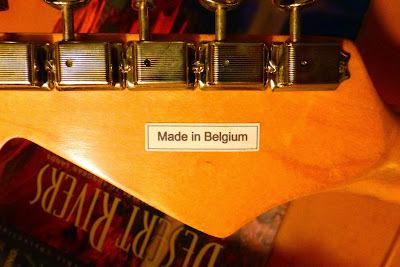
• And lastly, here's my take on the whole "where was it made?" thing - maybe it's a statement, maybe it's a joke, but - Belgium is about the coolest name for a country, ever. And besides, that's where the legendary Hercule Poirot was born. Good enough for me.
James Aoyama Custom, Strat, headstock, Gotoh tuning machines, tuners
Made In Belgium? Really?

Next, in Part 4, we'll finally get around to installing a tone control pot, after we audition a few tone capacitors first.  Also, who knows, there may be a new pickup or nickel plated part to put in, too, so stay tuned.

To see the first two installments of our journey with this Parts-O-Caster, go to Part 1, and Part 2.

As always, click or tap on any photo above to access larger, higher def images. All photos except Mr. Monk were taken with a Lumix ZS-25.