Showing posts with label Bicycles. Show all posts

Jonsan's Bridgestone XO-1 Build

Here's a special treat, another beautiful bike build from my younger, smarter brother, Jonsan. In an earlier guest blogpost from him, about his then- latest project, a Gazelle "Crossframe" cyclocross bicycle, I wrote this:

"My brother Jonsan has always had some cool and interesting bicycles, including the very first fixed gear bike I'd ever seen, a mid-80s Schwinn Madison (which now lives in my garage, and sometimes roams the streets of Eugene). He'll find a rare and/or beautiful frame and then build it up with top quality components, and every once in a while he sends me photos of his incredible creations." And now, without further ado, here, in his own words, is Jonsan:

For approximately a decade I have been wanting to find a 1993 Bridgestone XO-1. Among its unique features was a frame built with standard road tubing but sized for 26” wheels and the very unique moustache handlebar. While it originally came with 1.25” (32mm) tires which were considered wide-ish for the day it had clearance for much wider tires, a precursor to how the now popular “gravel” bikes are equipped. According the the 1993 Bridgestone catalog, only 1000 were made and my understanding is that they weren’t too popular and lots were leftover when they were discontinued the following year. I had a 1992 model which had similar specs but different colors for the frame and sidepull brakes but the 1993 which had an orange ("Construction Pumpkin” in the catalog) frame and cantilever brakes is the most desirable one to own.
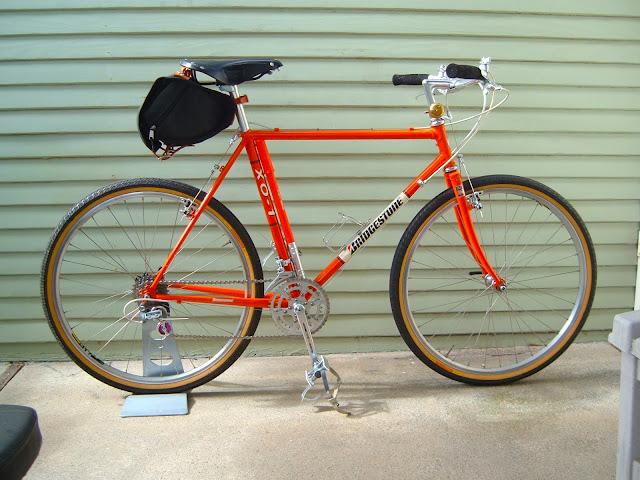

I found this in the local craigslist as a frameset only. It was in very nice shape for a frame that is close to 30 years old, so it appears to have not been ridden much. The gentleman who sold it is a big Bridgestone XO and Rivendell fan. He bought it knowing he was too tall for it hoping to trade it for a larger frame which didn’t materialize so he decided to sell. It wasn’t cheap (don’t ask) but it was priced several hundred dollars less than complete bikes go for, which is $$ saved for me as I had a specific build I wanted to do that didn’t include any of the original parts anyway.

All of the parts were already on hand to assemble the bike so no trips to the local bike shop or online purchases were necessary. The bottom bracket wasn’t the right length for the crankset I used and when I removed it the whole works were covered in metal shavings. I could still see paint on the outside edges of the bottom bracket shell so presumably the frame was prepped at the factory and then painted without cleaning up the mess beforehand! The headset felt a bit gritty to me so I disassembled it to regrease and adjust, and it was similarly full of shavings. Except for the headset cups (I did replace the bearings and their captive holders as I was too lazy to soak and clean the shaving encrusted moving bits) no other component is original to the bike.
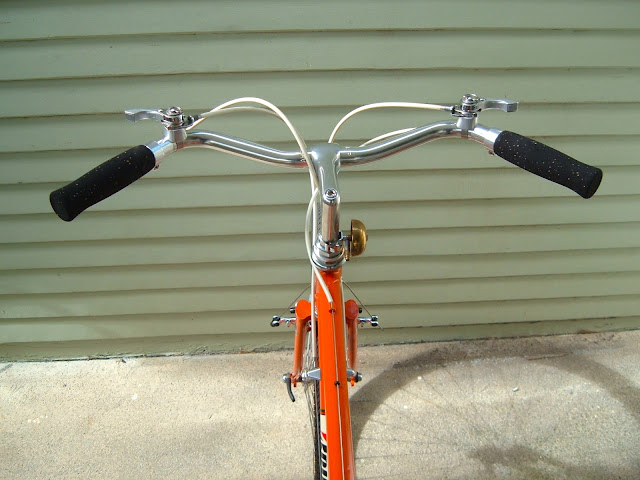
The bars and stem are set up for an in-between riding position, not leaning too forward or too upright, which I think suits the bike well. It climbs and accelerates good but not great, partly due to how my body is positioned and the rather pedestrian tires it is currently shod with. It does have a great ride quality and I love the way it looks, so I'm sure it'll be one of the last bikes I would ever part with.

Here's a build component list for those interested. I may make some changes along the way but I am in no rush to do so. Ignore the long-ish cable ends hanging out - I usually go for several rides to make sure everything is adjusted properly before I trim and attach the end cap thingies:

• Panaracer Pasela 26x1.75 (42mm) tires

• NOS Suntour XC Pro hubs laced with Sapim butted spokes to Mavic 317 rims by Ryan Mason of Mason Cyclewerks who sadly (for me) moved from Long Beach to northern Cal so I gotta find another wheel builder.

• Nitto "Young" (I think) stem

• Ahearne/MAP handlebars, made and sold by Joseph Ahearne and Mitch Pryor, a couple of custom frame builders. Pretty much a copy of the Cinelli "Priest" bars but with a 25.4 clamp diameter and a 22.2mm grip diameter and quite a bit heavier too. Also similar to the Nitto 2522 “Jitensha” handlebar except for a 1” rise instead of being flat.

• Velo Orange cork/rubber grips

• Real Design brake levers

• Suntour LD-2800 thumb shifters

• American Classic 27.0mm seatpost

• Brooks B17 saddle

• Campagnolo cantilever brakes - OK, these are actually made by Tektro presumably in Taiwan but I like ‘em and they are way easier to adjust than the older post style cantis 

• TA Cyclotouriste crankset, 42/32 chainrings

• MKS touring lite pedals with MKS alloy toe clips

• Sachs 13-26 7 speed freewheel

• Suntour ARX front derailleur

• Suntour Sprint 9000 rear derailleur with Bullseye pulleys

• Nitto touring bottle cage

• Silca framefit pump

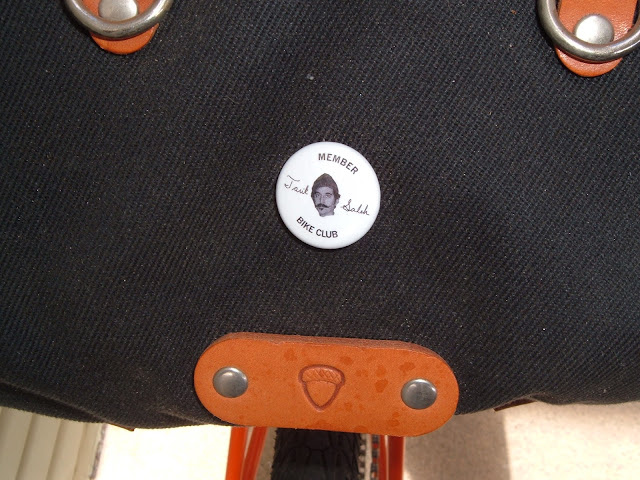
Acorn M/L saddlebag - Acorn bags are made here locally in Gardena by a husband and wife team who makes a batch of bags each month and posts them for sale on their website and sell out in a few minutes. My saddlebag fetish is due to influence from my older brother; all of my bikes have a bag, each with a Tarik Saleh Bike Club button attached. There are 2 club rules: "Ride bikes" and "Try not to be an ass":

 *                    *                    *
 
Editor's note: Another classic bicycle from the 1990s that had a similar design ethic and geometry as the Bridgestone X0-1 was the economy level B-Stone CB-0.
 
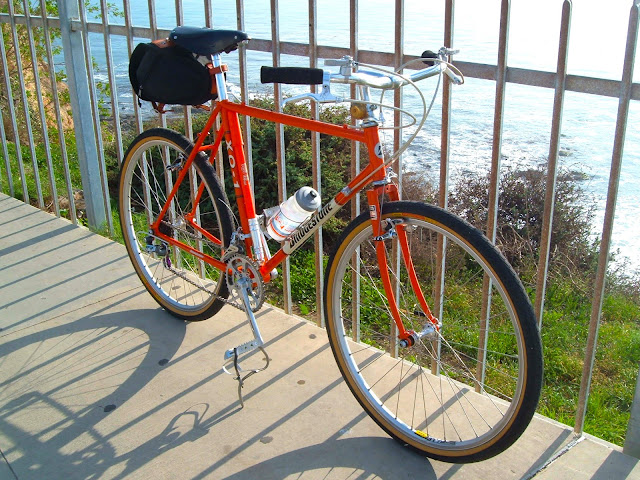
The first and last photos above of Jonsan's XO-1 show it parked at the edge of the known world - at the sudden, cut-off southern end of Pacific Ave in San Pedro, where the rest of the street had fallen down the cliff towards the Pacific Ocean in the semi-major earthquake of 1933.
 
Beyond the fence is an area that's always been known since the quake by San Pedrans, unofficially, as the "Sunken City". As late as the 1970s there were still recognizable remnants of the houses and shops that once lined that scenic seaside drive, but those ruins, now almost a century old, have become less visible as the years pass by and the soft sandstone cliff continues to crumble slowly into the sea.


"TrekStone": Trek + Bridgestone Ugly Town Bike Pt 2


It's another beautiful day in western Oregon. Yesterday, it was dark and dreary, and raining crazy cats and drippy dogs all day, a lot. And even that was beautiful; it keeps the air and sky clear.

It's been just about a year since Part 1 about this mongrel "TrekStone" Ugly Town Bike, a combo of a 1st gen Trek mountain bike main frame, and a Tom Ritchey designed Bridgestone MB-1 fork. Not a whole lot has changed on it since, except for the handlebars and the tires. Since this bike has recently become my go-to daily rider, I swapped out the humongous Continental Town and Country 26x1.9 bullet-proof pothole floaters for a pair of Sheng Shin 26x1.5 skin walls, which I got at Paul's Bikes' Alder St store a few years ago and never used.


These Sheng Shins have a nice evenly round cross section, with no shoulders and only a hint of tread, and they roll fast and corner smooth. Plus, light colored skin walls look vintage-y cool. Damn, I wish I would have bought 5 pair; never seen them since.

You may notice that I still haven't gotten around to getting the frame and fork painted. It would be a good idea to get that done, but it would mean tearing the bike down, and I'm having fun riding it. The B-Stone MB-1 fork is bare metal right now, and interestingly, even though it's really humid here, there's not a hint of rust on it. Might be the high manganese steel alloy, possibly, or maybe I'm just lucky.

The other change with the bike is a lower rise bar setup:


The Nitto North Road bars I had on previously were really great feeling, high quality, and looked 1930s European touristy, but the almost but not quite flat profile of these new bars is stylish in a whole different way. Acquired in a trade, I have no idea what these handlebars are called, or who made them; if you have any idea, let me know.

A plus with these bars is that since they're lower rise than the tourist bars, the stem can be raised in order to get to my preferred equal bar and saddle height riding stance. A taller stem has an interesting look in itself, for some reason. Maybe it's because more shiny metal is showing?


Since it's getting into the long rainy season here in the Willamette Valley, the next step is putting on a pair of fenders, or mud guards to you Brits. But not today; the sun is shining, the streets are almost dry, and I'm going for a ride.


1970s Motobecane Grand Record


    Here's a retro look back into another era: when steel frames were brazed up by hand, when there were numerous makers of fine bicycle parts throughout Europe and Japan, when there were small shops everywhere that would build a cycle for you from the frame up with your choice of components - all before Shimano, the Walmart of the bike biz, took over the world.

This classic style bike was built up from a Motobecane Grand Record frame, made in France, vintage early 1970s. The hand-brazed Grand Record frames were made with thin walled Reynolds 531 (say "five three one", not five-thirty-one) tubing. When unbuilt, this bare frame is extremely lightweight and rings nicely when tapped with a screwdriver handle or pencil.  The main frame has Campagnolo rear dropouts, and clean construction with no braze-on attachments - no shifter bosses; no top tube, downtube or chainstay cable guides; and no water bottle mounts to mar the lines.

As well, there is some outrageous and crazy-beautiful head tube lug work:


According to my brother Jonsan, who really knows about these things, the head tube "lugs are Nervex Professional, or close copies of Nervex.  Nervex Professional lugs were found on many high end bikes of the day, including Schwinn Paramount, Raleigh International, and Peugeot PX-10, coincidentally all of which used Reynolds 531 tubing".

The original fork had gotten fubared somehow long before I bought the frame; the replacement Reynolds 531 fork is a high quality Tange, made in Japan, with chrome fork tips and Suntour dropouts.  When I purchased this fork at Paul's Bike Shop on Alder St. in Eugene, it and the Campagnolo headset were personally fitted to the frame by Paul Nicholson, who also assembled and aligned the Phil Wood bottom bracket and TA cranks.  As many already know, when Paul himself comes out to the shop area and offers to work on your bike, the fee is nominal and two or three stories are also included at no extra charge.

Since the original fork had gotten messed up, I asked Louie at Blue Heron Bikes here in town to check the main frame alignment, and he cold set the head tube and chainstays; Louie happens to be the most knowledgeable and skilled bike tech in the known universe.  I then built this up as a daily driver, with all high quality European and Japanese components, mostly good-to-excellent condition used, but some NOS (New Old Stock), as follows:

• Headset:  Campagnolo (Italy)
• Handlebars:  Belleri (France), 42cm; the bar tops are double wrapped with tan cotton tape, with "naked" drops.  Velox (France) bar-end plugs.
• Stem:  Pivo (France), 80mm.
• Brakeset:  Weinmann (Switzerland), model 605; gum hoods on the levers, Kool Stop (Lake Oswego, OR) Continental "Salmon" pads, and transparent amber cable housing.  The calipers have mico-adjust quick releases and wheel guides.
• Top Tube Brake Cable Clips:  Campagnolo
• Shift Levers:  Campagnolo
• Down Tube Cable Guide:  Campagnolo
• Chainstay Cable Guide:  Suntour (Japan)
• Front Derailleur:  Campagnolo
• Rear Derailleur:  Suntour Cyclone Series I - a great shifting, beautiful and extremely lightweight changer.  Only the Huret Jubilee was lighter, and didn't shift nearly as well as the Suntour; in fact, the first series Cyclones are widely regarded as being possibly the best shifting rear mechs ever made.
• Freewheel:  Suntour Gran Compe; NOS, 14-17-20-24-28
• Crankset:  Specialities T.A. (France), 170mm arms.  This is not the more common Cyclo-Touriste model, but an ultra-rare racing "half-step" setup, with the chainring bolts much closer to the teeth, for added rigidity; close ratio (10%) 50 and 45 tooth chainrings.  Unlike the normal 23-27% "crossover" gearing seen on most all bikes, half-step gears, with an appropriate 5-cog freewheel such as the Suntour Gran Compe, allows for 10 distinct gear ratios, with no overlap.
• Chain:  Sram PC-58 - I love two tone chains.
• Bottom Bracket:  Phil Wood (USA); the best and smoothest sealed bearing BB in the world, really.
• Pedals:  Lyotard (France) Model 82, with NOS Cristophe (France) Medium+ clips.  Also has Cristophe leather straps and MKS strap pulls and shoe pads.
• Rear Wheel:  Normandy (France) high-flange hub with a Wolber Super Champion (France) rim; this wheel was NOS, like the Suntour freewheel that's on it.
• Front Wheel:  Maillard (France) low-flange hub w/ unknown, but probably Wolber, rim (the sticker is faded).
• Tires:  Continental Sport 1000, 27" x 1 1/4" (630x32mm); these cushy but responsive, high quality tires, made for roads in the real world, have gum sidewalls that match the color of the Weinmann brake lever hoods.
• Wheel Quick Release Skewers:  Campagnolo
• Saddle:  Ideale (France); solid brown leather, with brass rivets.
• Seatpost:  SR (Japan), 2-bolt true micro-adjust; very similar to, and looks quite like, an older Campy.  This seatpost was a gift from my brother Jonsan.
• Water Bottle Cage:  Specialites T.A. clamp-on type; I put a wrap of cotton bar tape under the clamps.

In addition to the above, all bearings, even down to the pedals, were completely torn down, cleaned, packed and adjusted; and the entire brakeset, including the levers, was disassembled, cleaned and relubed.  Plus a professionally done wheel truing, new tires (which are themselves classic-style older stock), new tubes, new chain, all new cables, new brake pads, new ball bearings as needed, etc, etc, etc...  It was a lot of work, but it was worth it - this classic old bicycle is solid, responsive, and corners fantastically.

And finally, that's a prototype of one of my own under saddle bags, a modification of an old French design and made right here in Eugene, USA, and one of these days I'll probably offer them for sale.  If you're interested, you can email me here.

Here's some more pictures (click or tap on any photo for larger, higher def images):

Enormous "Comfort" Bicycles

comfort, bicycle, fat people, overweight, exercise, large, heavy, crappy, obese

On the last really nice, sunny, and warm day of autumn I went for a ride, and so did a bunch of other bicyclists. There's a cycling and pedestrian trail that goes along Amazon Creek, and as usual for a nice day in Eugene, there was a lot of bike traffic. I got stuck for awhile behind a pair of cyclists out for a jaunt, side by side on their bright shiny new bikes with matching paint. Sorry for noticing, but these folks in front of me were massive, and their bikes were also king-sized. Or maybe it just looked that way, since they were both riding almost completely bolt upright, not leaning forward at all.

Another thing I noticed was how much both of them were bouncing up and down as they pedaled. A lot. I guess that's not surprising - most bikes made these days have suspension forks, and the combined mass of large bike and large rider will cause a bunch of unnecessary and energy sucking vertical movement. I'm not being critical, and it's great whenever someone takes the time and energy to get out there and do something like exercise. After ringing my bell, I gave them a smile, a wave, and a thank you as they pulled over to the right and I passed by.

An Admirable Cyclist (random internet image)

There's a lot of really interesting bicycles where I live, and I usually only notice unusual designs, or nicely kept up vintage cycles, or well built-up ugly city bikes, but suddenly I saw that there were a ton of these newer design bikes out there - all with immensely tall frames and even taller handlebars, ultra wide and huge balloony seats, and really long springer forks. I never even knew these bulky behemoths existed, but now I was curious, so I went to Paul's original shop on Alder Street to find out more:

Ever Fit, And Always Fun Guy Paul, And Friend, At The Alder St. Store

Here's what I found out from the helpful and friendly folks there: this new style of bicycle is called a "comfort bike", or sometimes "hybrid bike". The term comfort implies that it's a comfortable bike, and "hybrid" is marketing hype, with no connection to high-mileage cars, or anything at all, really. These comfort bikes, being humongous, are also really mega heavy - they're half jokingly referred to as being designed by lawyers: made from massively stout material, they'll withstand almost any treatment by less experienced, more portly pedalers without breaking; therefore, less lawsuits. A sad reality is that we now tend to be larger and heavier than humans have ever been; something like 2/3 of US adults are overweight, and these larger and heavier bikes were made to take us down the road, without collapsing from metal fatigue.


Anatomy Of A Comfort Bicycle

No matter what brand name is screen printed on the frame of a comfort bike, the vast majority of them are built in one or two of the colossally giant-ass factories of the Gigantic Bicycle Company in the manufacturing superpower of China. Ginormous quantities are sold each year, usually to folks with all the best intentions of a healthier new life, and tens of millions of these hulking beasts languish in dark back corners of garages all across the world, most of them in still pristine, barely ridden condition.

Strange Red Lines Through A Comfort Cyclist's Body

Take a comfort bike out for a spin, and the first thing you notice is how high up in the air you are. Also, it should be called an "exercise bike", since it takes so much effort to operate. Much of the energy usually transferred into forward motion is lost in front fork bounce, the dampening effect of the spring-loaded seat post, and heavy jumbo 700C tires, made to resist punctures while supporting a lot of weight. Having to overcome the sheer inertia of trying to get that monumental mass of metal, rubber, and flesh moving, plus the added wind resistance caused by the upright riding posture, and you can really feel those calories falling off after only a few blocks. It's no wonder that most of these elephantine bikes are hardly ever ridden after being bought - it's just too much like work, and not fun at all.

Even Stranger Yellow Arrows On A Comfort Cyclist

When I got out of the store and jumped back on the narrow, hard leather saddle of my old lightweight beater made of high tensile steel so naturally springy it feels almost alive, it was like an enormous weight had fallen off me. Just a few pedal strokes got me up to cruising speed, and it felt great riding effortlessly in the warm sun, with a light cool breeze - you might even say it was a comfort.

The Best Darn Pedals Ever

Union, Germany, bike, bicycle, autumn red maple leaves, bicycling, Eugene, OR

These are the greatest pedals ever, but something of a mystery. The local bike shop, Paul's on Alder St, had a few pairs of these sitting on a shelf gathering dust - I don't think they sell very many of them. Don't even know if they're still in production, and it's hard to tell what brand they actually are - there's no name on them. It says "Made In Germany" on the inside flange, along with a logo that may or may not have a letter "U" in it.

They're called rubber block pedals but the blocks are probably made of a fairly soft rubber-ish plastic. In any case, they have an amazing grip; once you plant your foot on one of the pedals, it stays there without any slippage. The bearings have almost zero play, and incredibly, almost zero friction - they spin smoother than even those great Japanese MKS pedals. They don't appear to be rebuildable, but a couple squirts of Phil's Tenacious oil once a year or so should keep them happy for a long time. We've been using them on most of our bikes here for over five years, and they're awesome and trouble free in any weather, as well as being ultra, ultra comfortable.

What's not to like? Well, you can't attach toe clips, so they're not as secure as you'd need for a fixed gear, but as they're the first to admit, fixie people are a bunch of crazies and who can tell what they'd like anyway? (Full disclosure notice: I have two fixed gear bikes, and ride them) Also, you'll have to not mind so much when, inevitably, the Bicycle Fashion Police walk up and say in their endearing way, "Whoa! Cute pedals! Where are your training wheels?" But who cares - ignore those assho people, and ride luxuriously in almost any shoe, whether high top sneakers, flats, Doc Ms, steel toed stompers, Daisy Duck pumps, high-heeled cowgirl boots, or wing tips. Zip on down to the coffee shop on a warm spring morning in your flip-flops, or heck, go bare foot - why not?

I'm not even going to get started about anyone saying "OMG, but you're not even connected to the pedals!" If you don't mind cycling in shoes you can't walk in, or if you believe you get some kind of 'performance edge' from using special pedals, hey, that's between you and your own personal bicycling god. All I know is that these rubber pedals get the job done, and look ultra retro and ultra cool doing it. Whatever they are.

"TrekStone": Trek 850 1st Gen + Bridgestone MB-1 Ugly City Bike

Trek 850, B-Stone, single speed, autumn, fall, Eugene, Oregon, red maple leaves

No matter how many nice bicycles you may have, it's a good idea to have at least one really ugly bike. It's great to be able to jump on and go without having to worry about your fine ride getting jacked when it's sitting there outside the Jiffy Market while you run inside to grab a coffee and a scone or a couple of micro brews. But if you're someone who couldn't ever see themselves on a crappy old beat up bike, well - just stop reading right now. Maybe look at the pretty pictures ugly pictures, and thanks for stopping by.

Here in Eugene, the bike theft capital of the known world, all bikes are at risk, but that's probably not the case where you live. In most places, a low-end or ugly bike will be totally safe with just a lightweight cable lock, or even nothing at all. In Colorado I never used a lock; instead, I wrapped an old black toe strap around the fork crown or rear brake bridge and the rim. It's almost invisible, but impossible to ride away on unless you remove the strap, which most thieves don't have time for or the brains to figure out:

Bridgestone MB-1, fork, dia compe cantilever, Eugene, oregon, Trek 850 bike frame

I never had a bike stolen, or even touched, until I moved to Eugene, where I've lost two. Some say it's because of the University (Duck U!) - not the students themselves, but all the slime bags lurking at the edges of society, preying upon the thousands of bicycles owned by students and faculty. True, but the bike theft problem here is also city wide. In Eugene, it doesn't matter what kind of lock or how many you have, if you leave a bike that looks like it's worth anything, it's gonna get hijacked.

What many riders do to reduce the anxiety factor is to have a beater bike, with good components and well set up, for commuting or general utility riding. An ugly city bike is less attractive in general, especially to thieves, and if it gets boosted, swiped, nabbed, jacked, filched, lifted, pinched or purloined, hey - it's no big loss.

Here's a truly crummy looking beater bike, a mid-80s Schwinn High Sierra. Under that crappy rattle can paint job (not my fault but I ain't fixing it) it's completely nickel plated so it should have a long, rust free and ugly life:

single speed, Eugene, Oregon, rain bike,

That's the yukkiest, who'd-want-to-steal-this bike I have; it's heavy and built like a tank, yet it has some virtues. As well as being virtually indestructible, it has almost exactly the same slack-angled, laid back frame geometry as a 1930s to '50s Schwinn cruiser newsboy bicycle, so it's really comfortable and tracks straight and true. You could fall asleep riding this cycle, and when you wake up you'll still be on the road.

My favorite ugly bike is something I put together a couple of years ago, my TrekStone:

B-Stone, Eugene, Oregon, Autumn, French canvas saddle bag, leather, lugged

The main frame is from a 1984 Trek 850, Trek's first mountain bike, and was found at a yard sale sans fork for $5.00. It's all lugged and brazed construction, fairly lightweight steel, appears to be well made, and still straight. I picked up the rescued Bridgestone MB-1 fork for $35 at the Center For Appropriate Transport non-profit shop. A friend working there (Hi, Alfred!) did a braze repair on the arch of the Tom Ritchey designed crown, a weak spot in an otherwise beautiful design, possibly the loveliest fork crown ever made. As you can see it hasn't been painted yet, so even though it's pretty, it's also ugly:

B-Stone, Eugene, Oregon, single speed, autumn, fall, red maple leaves,

The most expensive part on this bike is the handlebar, a new Nitto Northroad. A set of NOS Dia Compe cantilever brakes are also shiny nice and new, but were craigslist cheap. All of the rest of this build are the usual suspects pulled from my criminal lineup of formerly nice parts gone bad, and I've sunk maybe $125 total into this bike, including new tubes, cables, brake pads, and rubber block pedals.

The tires are ancient Continental Town And Country inverse tread fatties, which I've had on a few bikes over the years and are now worn out and more comfortable to ride than ever. My brother Jonsan would say they're dead feeling and unresponsive, and he's absolutely right - they are dead. And like zombies, they may be dead but never die. But these tires are also dead reliable, just about un-flattable, and good for either riding on pavement or doing in-town dirt rides down sometimes pretty technical terrain on deeply rutted and potholed back alleys, all the while dodging to avoid giant lethal thorned and very much alive carnivorous blackberry creepers.

bicycle, Eugene, oregon, fall, autumn, red maple leaves, canvas saddle bag, ugly city bike

Once again I got lucky using the FixMeUp gear ratio calculator, and it's great to be able to have a single speed with vertical dropouts without having to use a chain tensioner. A 42 tooth chainring with an 18 cog results in a 61 inch gear ratio, which is an okay compromise gear for most around town riding. For more reading about FixMeUp and single speed conversions, check out my post on a Bridgestone CB-0 single-speed.

The grips are old used tan cotton road bike bar tape, wrapped over thin foam and capped with big corks from bottles of bubbly "vino Italiano d'amore". I just made that up - what I mean is the bubbly wine called Lambrusco, and I gotta say, that stuff really works. If you know what I mean (nudge nudge, wink wink). Unless your special friend is some kind of wine snob, but who would want a wine snob for a friend? Maybe a hot wine snob, okay.

Classic European rubber block style pedals have great grip, nice smooth bearings, ride-able in any shoe, even barefoot or flip-flops - so what's not to like? And the seat is an old Japanese leather saddle that I've had like forever, goes on most of my favorite bikes, and not to get too personal but after all this time it fits very well down in "that" region. If you know what I mean.

This Trek frame has the longest chainstays known to man, and though it makes for slightly sluggish turns, it does have a super stable ride:

Japanese leather saddle, canvas saddle bag, Eugene, oregon, ugly city bike
 
Even though it's designed for an all-terrain bike, the frame has a fairly low bottom bracket, and would probably make for a nice touring machine. Trek's later mountain bikes had the usual shorter chainstays and higher bottom bracket height, and these first-gen 850s are the only ones made with this strange but interesting geometry. The fork and frame are from different decades and designers, but they go together well, and the combination has a surprisingly pleasant feel and true ride. Paired with Panaracer 1.5" skinwalls it can be quite zippy; even with old dead Contis this frame combo is still a lot of fun.

I'm thinking of eventually having the Trek frame and B-Stone fork painted some nice metallic color, sticking some derailleurs and pannier racks on it, and having a really cool looking touring bike. That's a possibility for a future long distance trek. For the present, I'm stuck in the city, and it's my favorite ugly bike.

And finally, that's one of my own under saddle bags, a modification of an old French design and made right here in Eugene, USA, and one of these days I'll probably offer them for sale; if you're interested, you can email me.

canvas saddle bag, leather saddle, autumn, fall color, Japanese maple, Eugene

Thanks for looking; all of the photos in this post can be clicked or tapped on for larger, higher-def images.


Autumn Bike Ride


The weather turned cooler, it's already rained a bunch, and although it's still fall, the long wet Northwest winter is not too far away, so it was time to put some fenders (mudguards to you Brits) on the Bridgestone CB-Ø. While I was at it, the handlebars were changed, rear racks installed, and some bags were hung on it and the saddle.

I took the CB-Zip for a shakedown ride on a cool crisp and sunny day, and took some pictures of the trip through autumn splendour down 10th Ave to the library, before I headed back toward the hills south of town, and home. And although wet slippery leaves can be a real hazard when it rains, on this fairly dry day it was a pleasure to cruise through crunching carpets of color: red, yellow, brown and gold.

In Japan, there is a word for the season of falling cherry blossoms - Sakura - and it has inspired poetic thoughts and feelings for some centuries. I wonder if they have a name for how it feels to ride under brightly colored autumn leaves as they slowly drift down upon your path ahead?

Bridgestone CB-Zip, fall color, Eugene Oregon, B-Stone CB-Zero, trees, red, gold
Bridgestone CB-Zip, fall color, Eugene Oregon, trees, gold, red, bicycle, autumn
fall color, Eugene Oregon, B-Stone CB-Zero, bike, leaves, autumn, ride, red
Bridgestone CB-Zip, fall color, Eugene Oregon, bicycle, trees, leaves, autumn, red

All photos taken with a Canon Digital Elph SD550, my indestructible old pocket camera. Click or tap on any picture for larger, higher resolution images.


Gazelle Crossframe Cyclocross, Part 2

Gazelle cyclocross bike, bicycle, build, Jonsan, Holland, Netherlands, Dutch, California
Gazelle at Bluff Cove, Palos Verdes Peninsula
Now it's time for Part 2 (see Part 1 here) of a guest blog post written by my brother Jonsan, about his Gazelle "Crossframe", a retired cyclocross racing frame made in Holland in the '80s that he recently built up:

"I took the Gazelle for an early morning ride out on the Palos Verdes Peninsula, one of the most beautiful cycling areas in the world. Lots of hills if you want, awesome views, and little traffic if you leave at the crack of dawn. I wanted to put in a good ride in Palos Verdes to add what are to me relevant thoughts about the handling, climbing, and general mojo factor, which are admittedly subjective evaluations, but I know what I like and don't like in a bike.

The 32 mm cross tubulars felt great in the dicey part of Portuguese Bend where the road is slowly shifting out to sea. Not as much cush as a wider high quality 650b tire but I felt totally secure. I won't ride any tire less than 28 mm up the coast anymore but most people out there on their carbon wonder machines are running 23s - I did for several decades. When standing up to sprint on a short incline the bike felt light on its feet, which is appreciated by a low wattage lightweight such as myself. The file tread of the cross tires is a little slower coasting but I am in no rush to get anywhere. I don't ride nearly as fast as I did when I was younger but I like a bike that feels like it surges forward when accelerating and in this regard the Gazelle shines. And of course visually a skinny tubed 80's cyclocross bike does look pretty cool.

Now for some more technical stuff for those inclined for such details:

The front derailleur cable routing goes along the top tube, then down the seat tube, and back up around a Sturmey Archer pulley to the derailleur. A clever re-purposing of a part originally designed for an English 3-speed, and added to a Dutch race bike:

lle cyclocross bike, bicycle, build, Jonsan, Holland, Netherlands, Dutch, California
Click or tap on any photo in this post for a higher definition (larger) image

The main triangle of the frame, which is made of the previously mentioned Reynolds 753, is an odd mix of metric tubing for the top tube and seat tube (26 mm and 28 mm) and regular, English-sized tubing for the down tube (28.6 mm, which is 1 1/8"). The lugs are Bocama Professional long point and it has a Cinelli bottom bracket shell.

A little history on Reynolds 753 might be in order if anyone cares. In the '70s Reynolds, maker of the famous and ubiquitous 531 tubeset used for decades by countless European pros decided to come out with a lighter set of tubing for competition. Using the same basic Manganese Moly steel alloy, it was heat treated for extra strength. The extra strength meant it could be drawn with thinner, lighter walls, to save a whopping 4 to 8 ounces over a comparable 531 frame. Not only is that not much weight savings, but there were also some added complications when building with 753.

Being heat treated, 753 tubes had to be low temperature silver brazed as opposed to the more common high temperature brass brazing, so as not to lose the temper of the steel and lose strength. The tubing also did not like to be bent too much or it would buckle so the frame had to be built with great care with regards to alignment, as it could not be cold set (cold setting refers to basically bending and manhandling a frame into alignment after it was brazed). Reynolds would only provide the tubeset to someone who was certified to build using 753. The certification process entailed Reynolds sending a set of tubes and lugs to a builder who would braze up the tubes and send it back to Reynolds for inspection.

This particular frame was likely built by Dutch 753 certified builder Jan Legrand who built frames for the 80's Dutch TI Raleigh professional team as well as 753 frames for Gazelle  Nowdays there are modern steel alloys that can withstand heat (and actually get stronger when heated) that can have even thinner, lighter walls, and be TIG welded. Most of them have larger diameters that to my eye do not look properly proportioned in smaller fame sizes. They are also a bit stiffer which is a personal preference for some, but not mine.

I am not sure if the Gazelle is a keeper just yet; it is kind of redundant for me as far as bikes go, since there isn't anything it can do that my Lyon doesn't do better  I'm actually thinking about having a rotating "guest bike" - something not part of the permanent collection, that I can put together and ride for 6-12 months or so and then take apart and store away, and then reintroduce something else from the past.

And regarding tubular tires, they are also known as "sewups", as many people (myself included) call them, especially in the US. "Tubular" is the more correct term so that is what I used here. They can be a little more work to install and a massive bummer if you get a flat early in their life, which fortunately does not happen too often, but they have a superior road feel over a comparably sized clincher. And they generally cost more but there are some very expensive high end clinchers out there now that arguably rival tubulars. The Pacenti 650b clincher tires I am using (sadly no longer made but there are some comparable and more expensive alternatives available) I would rate up there with a good sewup. And fatter, which is a huge plus. I have found that 650b tires (and wider tires in general) are no magic bullet, though - you still need to get high quality, supple, lightweight ones for their advantages to really be felt."

Thanks, Jonsan, for a great guest blog post, and maybe we can talk you into doing another soon!

To view the first post about this Gazelle, click here.

Gazelle Crossframe Cyclocross, Part 1

lle cyclocross bike, bicycle, build, Jonsan, Holland, Netherlands, Dutch, California

My brother Jonsan has always had some cool and interesting bicycles, including the very first fixed gear bike I'd ever seen, a mid-80s Schwinn Madison (which now lives in my garage, and sometimes roams the streets of Eugene). He'll find a rare and/or beautiful frame and then build it up with top quality components, and every once in a while he sends me photos of his incredible creations. I've asked him to do a couple guest blog posts about his latest project, a Gazelle "Crossframe" cyclocross bike (for part 2, click here):

"A couple of years back I started to recognize the benefits of tires wider than the 23 mm I had ridden for decades. I tried a touring bike, a fairly highly regarded one (Specialized Expedition), and it was yuck. I think the thicker walled tubing touring bikes have for carrying loads makes the bike feel sluggish when ridden unloaded.

I wanted something a little racier, but vintage-y, so I started looking for a vintage cyclocross bike.  Cyclocross bikes are all the rage now and easy to find but in the 70's and 80's they were pretty much unknown in this country except for a few brought in for a very small core of 'cross riders. The easiest ones to find (and still not that easy) were the Italian ALAN aluminum ones. I found one and was pretty stoked about it, but after I built it up and went for a few rides it also had to go. With powerful cantilever brakes, the aluminum fork would flex like crazy when braking hard, so much so that I was afraid it would eventually snap. You could literally see the fork blades flex back an inch when coming to a quick stop. I sold the ALAN and started looking. And kept looking.

By some miracle I eventually found a Gazelle cyclocross frame, an ex race bike, that would fit me.  The tubing is Reynolds 753 which was state of the art for its day and is the lightest steel frame I have ever owned. The serial number indicates it was made in 1984 but the decals are circa 1989. Apparently the rear dropout broke (presumably in a crash) and a new one was installed and the frame was repainted. Being a true cyclocross bike meant for racing, it has a high bottom bracket and no water bottle braze ons. Back then road racers ran 20-22 mm tubulars; this frame was designed around 28 mm cross tubulars which were considered wide back then, so it does not have the clearance of a modern frame. I ran it with 29 mm clinchers for awhile but after I acquired a Lyon frame, 29 mm tires didn't seem very wide anymore so I took the Gazelle apart and into the attic it went.

I recently decided to give it another shot using 32 mm cyclocross tubulars; the rear wheel had to be moved back in the dropouts to gain enough clearance. I was originally running 39/44 chainrings which would be similar to what it originally had. In 'cross racing there is no need for super low gearing as it is faster to hop off the bike and shoulder it up a short steep incline rather than spinning a low gear. I rebuilt it with some of the parts off of a disassembled Bridgestone XO-1. The front derailleur has a braze on mount and I had to stick with a 44 large chainring as I couldn't lower the front mech any lower. I am using a 32 small chainring and I have to be careful when shifting the front as I have limited adjustment for the derailleur.

With 32 mm tubulars at 45psi front and 50psi rear, it has a nice cush but still accelerates and climbs well. Without the pump and spare tire it is 20.5 pounds which ain't bad. I have a set of 30 mm road tubulars aging and someday will install them which should make the bike feel faster yet. I also need to install a stem 1 cm longer which will wait for another day when I can play musical stems."

Here's a couple of shots of the Gazelle's front end; check out the nice cut-out Bocama head tube lugs:

cyclocross bike, bicycle, build, Jonsan, Holland, Netherlands, Dutch, California
Click or tap on any photo in this post for a higher definition (larger) image.

The main components are:

• Campagnolo C Record hubs laced to Mavic GEL 280 rims (as in 280 grams, pretty much as light as they come)
• Challenge Grifo XS 32 mm tubular tires *see note below*
• TA Cyclotouriste crankset 44/32
• Dura Ace freewheel 14-16-18-20-23-26
• Campagnolo C Record braze-on front derailleur
• Suntour Sprint rear derailleur
• Suntour XC ratcheting thumbshifters
• Nitto Dynamic stem, 11 cm
• Nitto Jitensha bars, cork grips (mainly to match the saddle)
• Real Design brake levers
• Brakes are Velo Orange cantilevers with "peace sign" cable hangers. I found out the
hard way that some older canti brake studs are spaced differently and many newer
cantilever brakes cannot be adjusted properly when mounted on them. I'm sure vintage Mafac or Weinmann cantis would fit but I prefer to have more adjustability with regards to toe-in of the brake shoes and I like the replaceable Kool Stop cartridge pads
• Campagnolo Chorus seatpost
• Brooks Swallow Ti saddle

*Note -  For those of us unfamiliar with tubular tires, Sheldon Brown's Bicycle Glossary defines them as: "A type of tire mainly used for racing.  A tubular tire has no beads; instead, the two edges of the carcass are sewn together (hence the term "sew-up") with the inner tube inside. Tubulars fit only on special rims, where they are held on by cement."

In Part 2, we'll take this vintage cyclocross bike out for a ride, and talk some more about this Gazelle and the Reynolds 753 tubing that it's constructed with. Stay tuned!